
16/01/2026 – El equipo de coordinación de la participación nacional en el proyecto SKA asistió el pasado mes de diciembre a la II Jornada de Grandes Infraestructuras de Investigación del CSIC y al Big Science Industry Forum Spain (BSIFS).
The coordination team for the Spanish participation in the SKA project (SKA-Spain) took part in two national forums related to large scientific infrastructures, reinforcing the key role of the scientific community and national industry in areas such as scientific data management, Open Science, digital transformation, and artificial intelligence.
Within the framework of the II Jornada de Grandes Infraestructuras de Investigación del CSIC, held on 2nd December, Julián Garrido from the Instituto de Astrofísica de Andalucía (IAA-CSIC), and co-PI of the SKA-Spain coordination, participated in the round table “EOSC en el CSIC. Gestión de datos en las Grandes Infraestructuras de Investigación: estrategia, impacto y ciencia abierta”. During his intervention, Garrido presented the SKA Observatory (SKAO) as an example of an infrastructure that will foster Open Science, highlighting the challenges associated with managing massive data volumes (on the order of hundreds of petabytes per year). He also emphasized the role of the international SKA Regional Centres (SRCNet) as a key element to guarantee access, processing and scientific reuse of these data.
The discussion underscored the need for robust institutional strategies and sustained funding for data management, as well as the importance of integrating the FAIR principles and Open Science as foundational elements of scientific infrastructures. In this context, the efforts made in Spain to incorporate scientific reproducibility as a success metric within the SKA were highlighted, along with initiatives to ensure that, after embargo periods, data are integrated into public archives accessible to the scientific community. The potential role of the European Open Science Cloud (EOSC) as a reference framework to reduce technological barriers for researchers and data managers was also discussed.
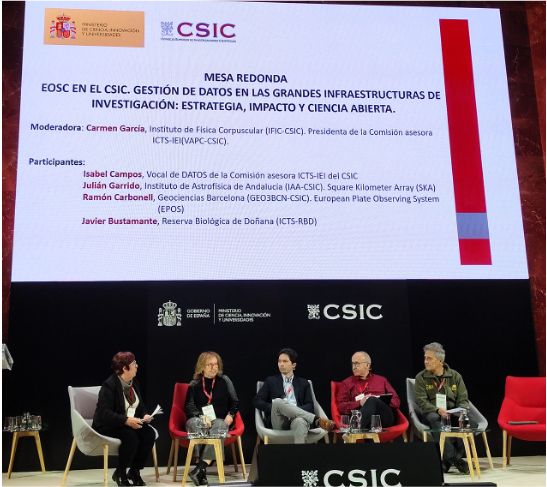
From left to right: Carmen García (IFIC-CSIC – Chair of the CSIC ICTS-IEI Advisory Committee and moderator of the session); Isabel Campos (IFCA-CSIC – Data Representative of the CSIC ICTS-IEI Advisory Committee); Julián Garrido (IAA-CSIC – co-PI of the coordination of SKA-Spain); Ramón Carbonell (GEO3BCN-CSIC – Vice-Chair of the CSIC ICTS-IEI Advisory Committee); and Javier Bustamante (EBD-CSIC – Deputy Director of the ICTS-DOÑANA).
On the other hand, the SKA project was also represented at the Big Science Industry Forum Spain (BSIFS), held on 3–4th December 2025. The participation of Spanish companies involved in the project, together with the SKA-Spain coordination team, made it possible to share experience in flagship scientific infrastructures such as the SKAO, particularly in aspects related to large-scale data management, Open Science, and sustainability. Specifically, Lourdes Verdes-Montenegro (IAA-CSIC), coordinator of SKA-Spain, took part in the round table “Transformación digital e Inteligencia Artificial”This session, focused on interaction between science and industry, addressed the impact of Artificial Intelligence as a driver of technological, productive, and social change. During her intervention, Verdes-Montenegro highlighted the role of the TED4SKA project in developing AI-based solutions to optimize energy sustainability and data management at the Spanish node of the SRCNet (espSRC), stressing the need to ensure the reproducibility and reliability of scientific results in an increasingly automated environment.
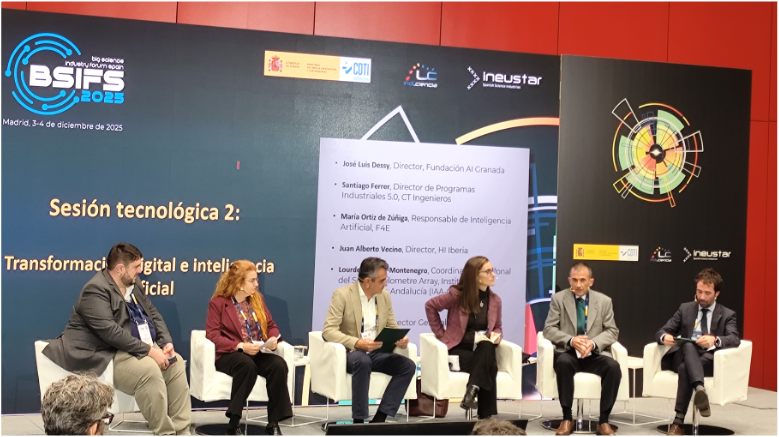
From left to right: José Luis Dessy (Director of the AI Granada Foundation); Lourdes Verdes-Montenegro (Research Professor at IAA-CSIC and Coordinator of SKA-Spain); Juan Alberto Vecino (Director of HI Iberia); María Ortiz (Head of Artificial Intelligence at F4E); Santiago Ferrer (Director of Industrial Programs 5.0 at CT Ingenieros); and Eric Fernandez (CEO of Ineustar and session moderator).
The BSIFS also highlighted the importance of strengthening connections between large scientific infrastructures and the national industrial ecosystem, identifying the need for specialized talent, public–private cooperation, and regulatory frameworks that promote the responsible adoption of Artificial Intelligence. “The organization of this type of activity helps to establish highly valuable dialogues for the scientific community, the science industry, and society,” notes Verdes-Montenegro. In this context, the event organizers facilitated meetings between participants. The coordination team held formal meetings with seven companies that expressed interest in the SKAO and the SRCNet, as well as in potential future opportunities for industrial participation.