

SKA Regional Centres
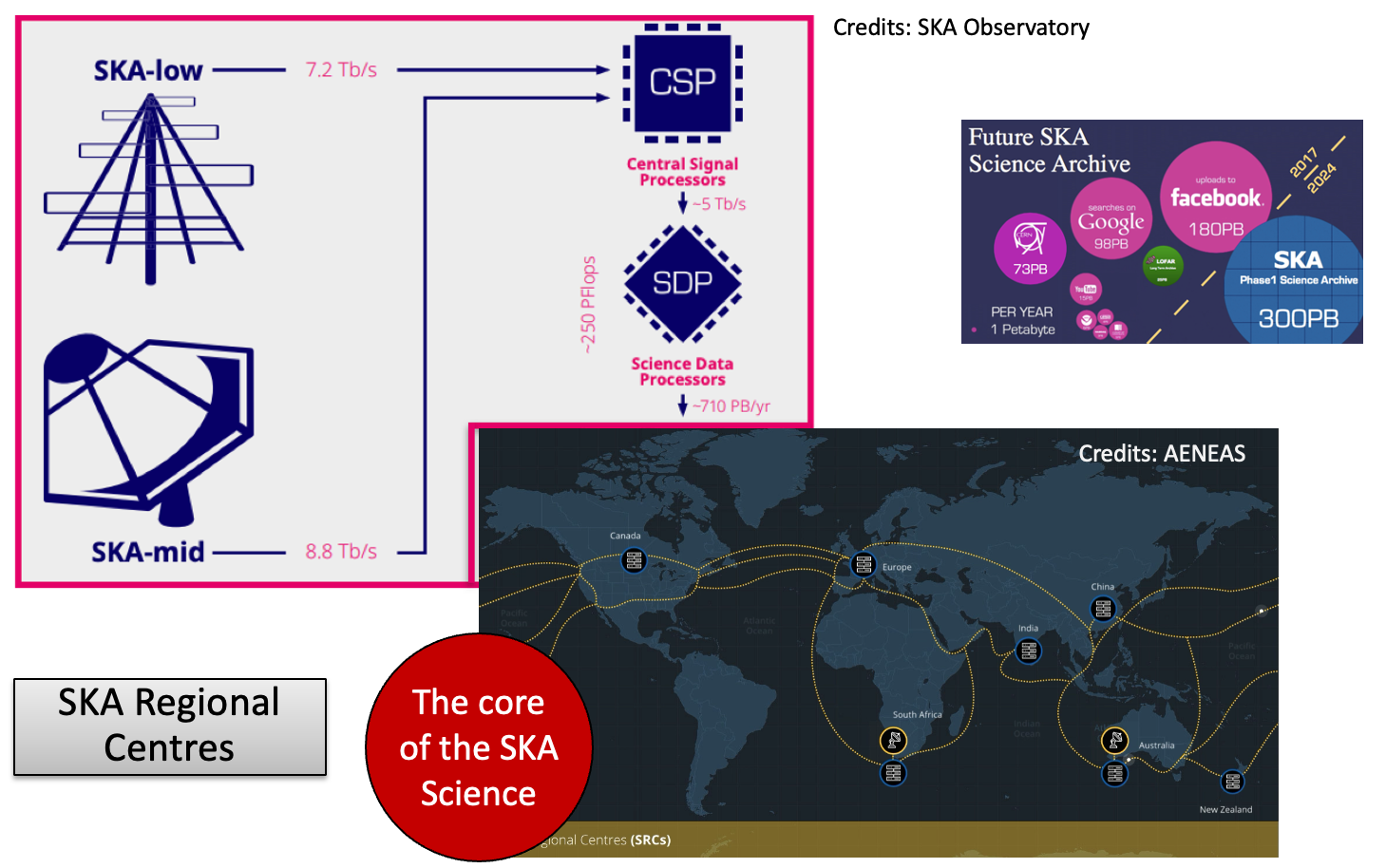
SKAO’s data will be distributed to an international network of SKA Regional Centers (SRCs), the SRCNet. These SRCs will offer access to SKAO data products (~700 Petabytes/year), computational and storage resources, and scientific analysis support. 17 SRC initiatives from 17 countries are jointly developing the SRCNet in collaboration with the SKAO.
The volume of data generated by the SKA will reach exascale levels, and an international Network of SKA Regional Centres (SRCNet) will be necessary to process the data produced by the SKA Observatory (SKAO) for scientific analysis. The Institute of Astrophysics of Andalusia (IAA-CSIC) has been leading the development of a Spanish SRC (espSRC) since 2018 being one of the strategic objectives of the Severo Ochoa programme funded by several projects. . The espSRC is a scientific cloud platform that provides access to data, analysis tools, scientific and technical support, computational resources, and training in new methodologies, services, and tools that facilitate Open Science.
The objectives of the espSRC are as follows:
- Maximise the scientific return on investment in the SKAO during the development, construction, and scientific operations phases.
- Support the Spanish scientific community to strengthen its position in SKA Key Science Projects. SKA Key Science Projects.
- Support the participation in precursor and pathfinder telescope projects related to SKA.
- Enable the community to acquire scientific and technical capabilities for SKA science through the SRCNet, following the principles of Open Science.
- Strengthen multifrequency/multimessenger synergies at the level of both national and international astronomical infrastructures.
- Align developments with the activities of the international SRCNet.
After analysing the requirements provided by various scientific groups, the scientific platform of the espSRC was deployed in 2020 and began operations in early 2021. Since the platform became operational, espSRC has supported more than 100 research, training, and development projects. These include prototyping efforts aimed at consolidating the technical capabilities of the SRCNet (e.g., network testing, file development, comparative evaluation of workflows, deployment of Kubernetes clusters, and repository services, as well as the Virtual Observatory). As a result, more than 40 scientific and technical papers include the espSRC in their acknowledgements for the uso of the platform.
The services offered as well as the conditions and access form can be found at the following link.
The espSRC is being developed following the principles of Open Science and in line with green computing, aspects that UNESCO associates with the Sustainable Development Goals, knowledge exchange, and inclusivity. Within the framework of espSRC, technological results are expected, such as the optimisation of computing capabilities and energy consumption, which will be shared with the SKAO and the SRCNet. This contributes to a considerable reduction of energy consumption in these types of centres.
By the end of 2019, the SKA Regional Centres Steering Committee established six working groups (WGs) to extract requirements in the areas of data logistics (WG1), operations (WG2), federated computing and service platforms for software and data (WG3), SKA scientific archive (WG4), computing (WG5), and community engagement requirements (WG6). After that, the WG0 was formed focused on architecture. The espSRC team participated in all seven WGs and led WG4. WG6 also included representation from the following Spanish centres: Instituto de Ciencias del Espacio (ICE-CSIC), Observatorio Astronómico Nacional (OAN), Univ. de Valencia (UV), and Instituto de Física de Cantabria (IFCA-CSIC/UC), as well as WG3 had representation from the Barcelona Supercomputing Centre (BSC).
In 2022, the prototyping phase of the SRCNet began with the participation of seven international teams, including one led by members of the espSRC team (referred to as the “Coral Team”). During this stage, the espSRC serves as a testing ground for evaluating various technologies to be implemented in the SRCNet. As such, the espSRC operates in two modes: production mode, supporting scientific projects, and development mode for SRCNet prototyping.
Efforts are underway to gradually expand the capabilities of the espSRC, both in terms of computational and storage resources, as well as the services provided, with the goal of supporting the national community. The scientific platform of the espSRC has already begun serving both national and foreign teams. In 2021 and 2023, the espSRC hosted teams participating in the SKA Data Challenges 2 (SDC2) and 3a (SDC3a), respectively. One of the Spanish teams in SDC2 was led by the IAA-CSIC and achieved the only gold award for reproducibility. IFCA-CSIC/UC led the Spanish team in SDC3a, earning the reproducibility badge. Additionally, the Centro de Supercomputación de Galicia (CESGA), a member of the Spanish SKA network (RedSKA), hosted one of the international teams participating in SDC3a.
The members of the espSRC espSRC initiative have actively contributed to the development of the services included in the SRCNet v0.1, the first operational version of the SRCNet with stable resources. The experience gained during this process was key to the espSRC becoming the first certified node of the SRCNet v0.1 in February 2025, followed by eight other nodes. Currently, the espSRC development team continues to work on scaling the infrastructure’s capabilities to a fully operational version of the SRCNet. This version is expected to be completed by the formal start of the SKAO operations and for the intermediate stages of science verification.