Mar 6, 2026 | All, Science, SKA-spain
La investigadora del Centro de Astrobiología (CAB, INTA-CSIC) y miembro del Grupo de Ciencia de SKAO «Cuna de la vida», ha sido galardonada en la VI Edición de los Premios FRACE-Mastercard al Joven Talento Científico Femenino por sus estudios sobre el origen de la vida en el espacio.
La astrofísica Izaskun Jiménez-Serra ha sido distinguida con el prestigioso premio Mastercard-Fundación Real Academia de Ciencias de España (FRACE) en la categoría de Física y Química. Este galardón busca visibilizar el liderazgo de las mujeres en las disciplinas STEM y consolidar referentes para las nuevas generaciones de científicas.
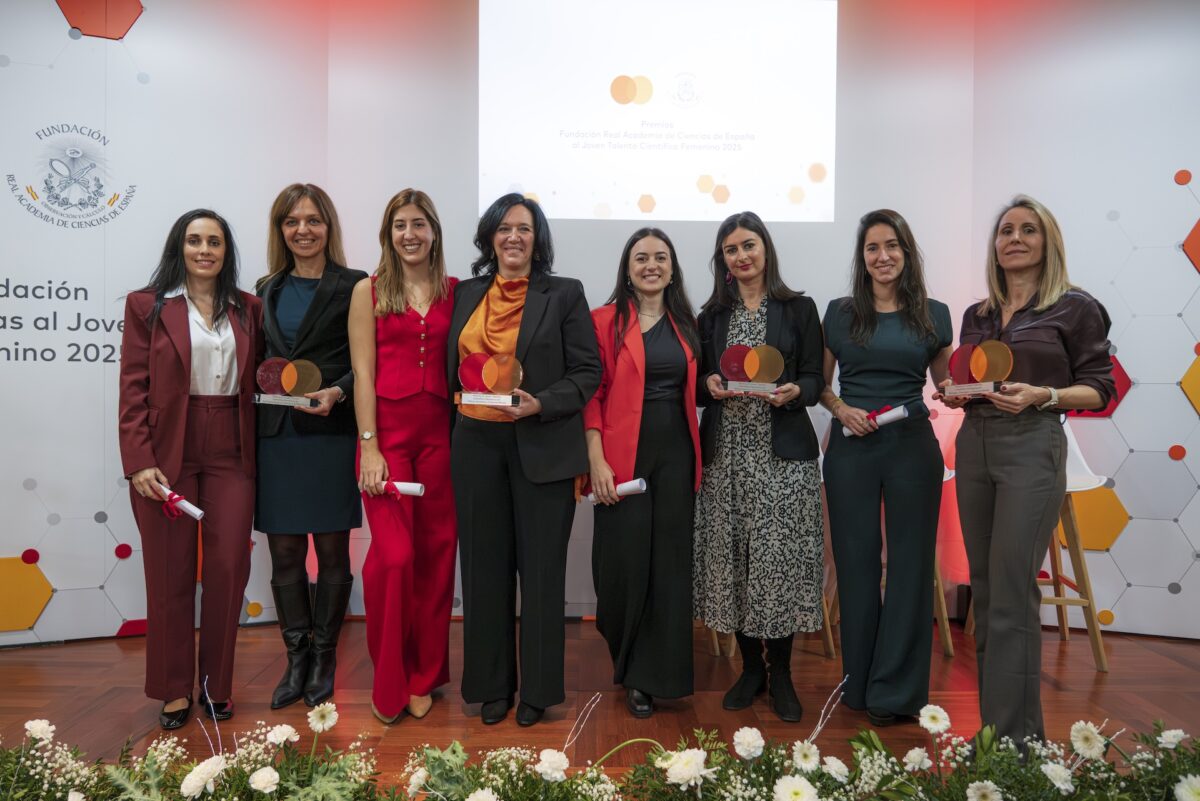
Izaskun Jiménez-Serra (cuarta desde la izquierda) junto con otras mujeres galardonadas en la VI Edición de los Premios FRACE al Joven Talento Científico Femenino.
Fuente: FRACE
Contribuciones pioneras al origen de la vida
El jurado ha reconocido a Jiménez-Serra por sus contribuciones pioneras y de alto impacto en la astroquímica. Su trabajo de investigación se centra en la detección de moléculas orgánicas complejas en nubes interestelares, un paso fundamental para comprender los procesos químicos asociados al origen de la vida en el universo.
La investigadora, que desarrolla su labor en el Centro de Astrobiología (CAB, INTA-CSIC), expresó durante la ceremonia de entrega su deseo de que este reconocimiento sirva de motor para otras mujeres: «Me siento muy honrada. Mi deseo es que este premio inspire a niñas, jóvenes y mujeres a creer en sí mismas y a perseguir su sueño».
Liderazgo internacional: El proyecto SKA
El jurado también destaca su liderazgo científico internacional. Un aspecto clave de su trayectoria es su papel en el Observatorio del SKA como miembro de Science Working Group de «SKA Cradle of Life» (Cuna de la Vida), grupo que copresidió de 2017 a 2020 . En este grupo de trabajo, su experiencia es vital para coordinar las estrategias de observación que buscan responder a una de las preguntas más fascinantes de la ciencia: cómo se forman las estrellas y planetas, y cómo surgen las condiciones químicas necesarias para la vida.
Una trayectoria de excelencia
Con este premio, la Fundación Real Academia de Ciencias subraya no solo la calidad técnica de sus hallazgos, sino también su capacidad de gestión y dirección en proyectos de gran envergadura. En esta sexta edición, se presentaron un total de 346 candidaturas, lo que pone de relieve la competitividad y el altísimo nivel de las investigadoras españolas actuales.
El galardón Mastercard-FRACE reafirma a Izaskun Jiménez Serra como una de las figuras más influyentes en la astrofísica nacional, cuya labor en las fronteras de la física y la química sigue arrojando luz sobre nuestras raíces cósmicas.
Jan 16, 2026 | All, Industry, SKA-spain
16/01/2026 – El equipo de coordinación de la participación nacional en el proyecto SKA asistió el pasado mes de diciembre a la II Jornada de Grandes Infraestructuras de Investigación del CSIC y al Big Science Industry Forum Spain (BSIFS).
The coordination team for the Spanish participation in the SKA project (SKA-Spain) took part in two national forums related to large scientific infrastructures, reinforcing the key role of the scientific community and national industry in areas such as scientific data management, Open Science, digital transformation, and artificial intelligence.
Within the framework of the II Jornada de Grandes Infraestructuras de Investigación del CSIC, held on 2nd December, Julián Garrido from the Instituto de Astrofísica de Andalucía (IAA-CSIC), and co-PI of the SKA-Spain coordination, participated in the round table “EOSC en el CSIC. Gestión de datos en las Grandes Infraestructuras de Investigación: estrategia, impacto y ciencia abierta”. During his intervention, Garrido presented the SKA Observatory (SKAO) as an example of an infrastructure that will foster Open Science, highlighting the challenges associated with managing massive data volumes (on the order of hundreds of petabytes per year). He also emphasized the role of the international SKA Regional Centres (SRCNet) as a key element to guarantee access, processing and scientific reuse of these data.
The discussion underscored the need for robust institutional strategies and sustained funding for data management, as well as the importance of integrating the FAIR principles and Open Science as foundational elements of scientific infrastructures. In this context, the efforts made in Spain to incorporate scientific reproducibility as a success metric within the SKA were highlighted, along with initiatives to ensure that, after embargo periods, data are integrated into public archives accessible to the scientific community. The potential role of the European Open Science Cloud (EOSC) as a reference framework to reduce technological barriers for researchers and data managers was also discussed.
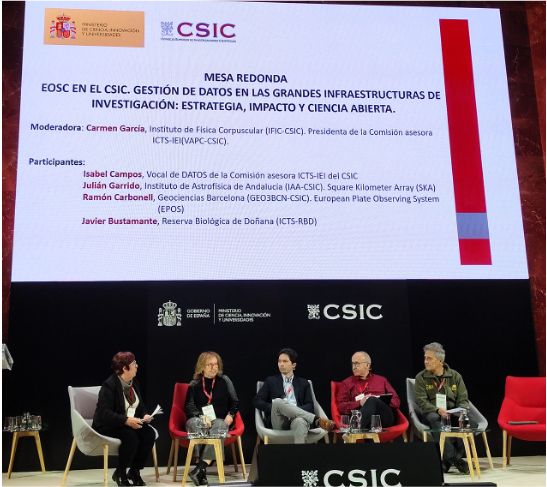
From left to right: Carmen García (IFIC-CSIC – Chair of the CSIC ICTS-IEI Advisory Committee and moderator of the session); Isabel Campos (IFCA-CSIC – Data Representative of the CSIC ICTS-IEI Advisory Committee); Julián Garrido (IAA-CSIC – co-PI of the coordination of SKA-Spain); Ramón Carbonell (GEO3BCN-CSIC – Vice-Chair of the CSIC ICTS-IEI Advisory Committee); and Javier Bustamante (EBD-CSIC – Deputy Director of the ICTS-DOÑANA).
On the other hand, the SKA project was also represented at the Big Science Industry Forum Spain (BSIFS), held on 3–4th December 2025. The participation of Spanish companies involved in the project, together with the SKA-Spain coordination team, made it possible to share experience in flagship scientific infrastructures such as the SKAO, particularly in aspects related to large-scale data management, Open Science, and sustainability. Specifically, Lourdes Verdes-Montenegro (IAA-CSIC), coordinator of SKA-Spain, took part in the round table “Transformación digital e Inteligencia Artificial”This session, focused on interaction between science and industry, addressed the impact of Artificial Intelligence as a driver of technological, productive, and social change. During her intervention, Verdes-Montenegro highlighted the role of the TED4SKA project in developing AI-based solutions to optimize energy sustainability and data management at the Spanish node of the SRCNet (espSRC), stressing the need to ensure the reproducibility and reliability of scientific results in an increasingly automated environment.
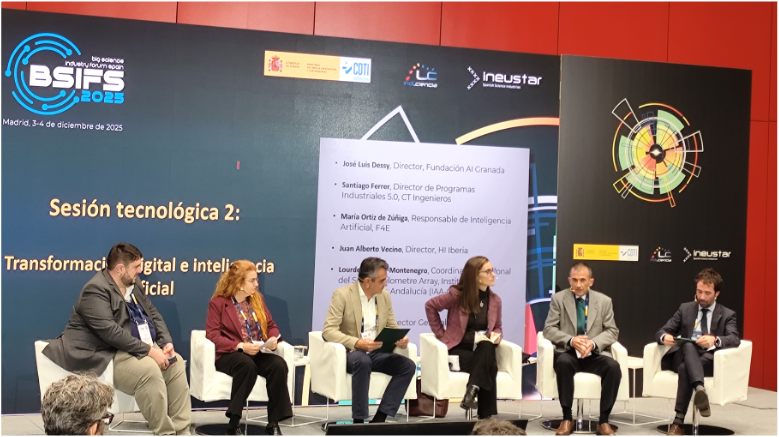
From left to right: José Luis Dessy (Director of the AI Granada Foundation); Lourdes Verdes-Montenegro (Research Professor at IAA-CSIC and Coordinator of SKA-Spain); Juan Alberto Vecino (Director of HI Iberia); María Ortiz (Head of Artificial Intelligence at F4E); Santiago Ferrer (Director of Industrial Programs 5.0 at CT Ingenieros); and Eric Fernandez (CEO of Ineustar and session moderator).
The BSIFS also highlighted the importance of strengthening connections between large scientific infrastructures and the national industrial ecosystem, identifying the need for specialized talent, public–private cooperation, and regulatory frameworks that promote the responsible adoption of Artificial Intelligence. “The organization of this type of activity helps to establish highly valuable dialogues for the scientific community, the science industry, and society,” notes Verdes-Montenegro. In this context, the event organizers facilitated meetings between participants. The coordination team held formal meetings with seven companies that expressed interest in the SKAO and the SRCNet, as well as in potential future opportunities for industrial participation.
May 29, 2025 | All, SKA-spain
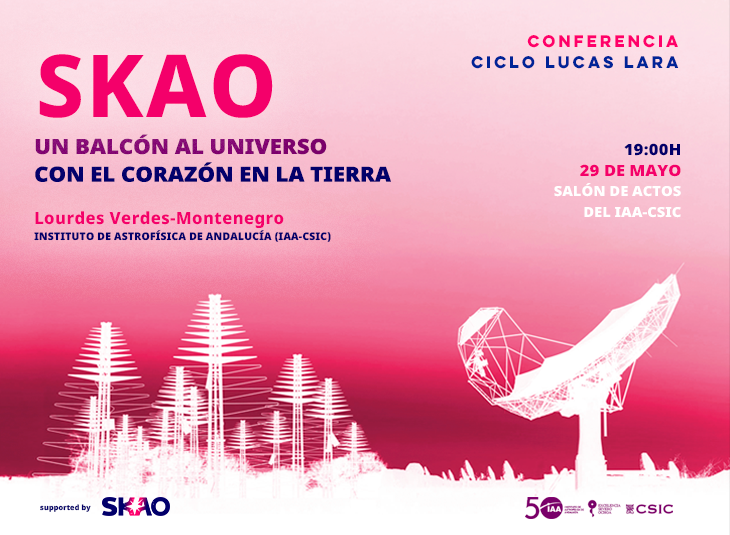
29/05/2025 – The SKAO, a balcony to the Universe with its heart on Earth 05/29/2025 – SKAO, a balcony to the Universe with its heart on Earth, is the title of a public talk in the Lucas Lara lecture series, which will take place on Thursday, May 29 at 7:00 p.m. in the IAA-CSIC Auditorium, Granada, Spain.
The speaker is Lourdes Verdes-Montenegro, who has coordinated Spanish participation in this project since its inception. This is a great opportunity to learn how a large astronomical observational facility, with unprecedented sensitivity and complexity, is conceived, built, and organised. Also, to learn about the construction of these telescopes in remote regions of South Africa and Australia.
In this talk, we'll learn about the latest developments and Spain's participation in the project. We'll also learn about the status of the SKA International Network of Regional Centres, for which one node is being developed in Spain. These centres are essential for the community to access the vast amount of data the telescopes will generate and to benefit from tools, technical support, and specialised training.
From this point on, we will open a window to the lesser-known dimensions of SKAO: the challenge of interference caused by mega-satellite constellations, cooperation with Africa and Indigenous tribes in Australia, Open Science, respect for the environment, and the creation of opportunities beyond science. This is an invitation to observe the Universe with the most advanced technology... and with your feet firmly on the ground.
Poster:
Feb 27, 2025 | All, SKA-spain, SRCs
27/02/2025 – The Spanish prototype of the SKA Regional Centre, under development by the IAA-CSIC, becomes the first centre to successfully complete its integration into SRCNet0.1, the first operational version of the international network that will constitute the scientific heart of the SKA Observatory (SKAO).
SKAO is an international organization building two state-of-the-art radio telescopes: SKA-Low in Australia, with over 130,000 dipole antennas for transmitting and receiving radio waves, and SKA-Mid in South Africa, with 197 parabolic antennas, each 15 meters in diameter. When the observatory's telescopes are operational, they will generate over 700 million gigabytes of data annually. All this data will be housed at SKA Regional Centres (SRCs), where it can also be accessed remotely. The various SRCs, distributed around the world, will be interconnected, forming a global network: SRCNet.
Last Monday, February 24, it was announced that the Spanish prototype of the SKA Regional Center, being developed at the Institute of Astrophysics of Andalusia (IAA-CSIC), was the first to complete the deployment and integration of the services required to become part of SRCNet0.1. This initial operational version of the international network will be fundamental for the functioning of the SKA Observatory (SKAO).
The Spanish prototype of SRC, called espSRC, is one of 17 national initiatives contributing to the development of SRCNet. “We have been working on this project since 2019, demonstrating our firm commitment to the development of SRCNet as a collaborative platform. Being the first center to deploy the necessary services to become an SRCNet0.1 node is a result of this commitment and close collaboration with the other international groups involved,” says Susana Sánchez-Expósito, technical coordinator of espSRC at the IAA-CSIC. “We currently have a fully functional system that has served more than 30 scientific projects in different branches of astrophysics,” she adds. Isabel Márquez, scientific director of the Severo Ochoa program at the IAA-CSIC, also highlights: “It is this multidisciplinary approach that makes the SRC prototype one of the key pillars, and a cross-cutting element in our scientific strategy, funded by our Severo Ochoa excellence project. Having an infrastructure of this level at our center positions Andalusia and Spain within the international SKA collaboration.”
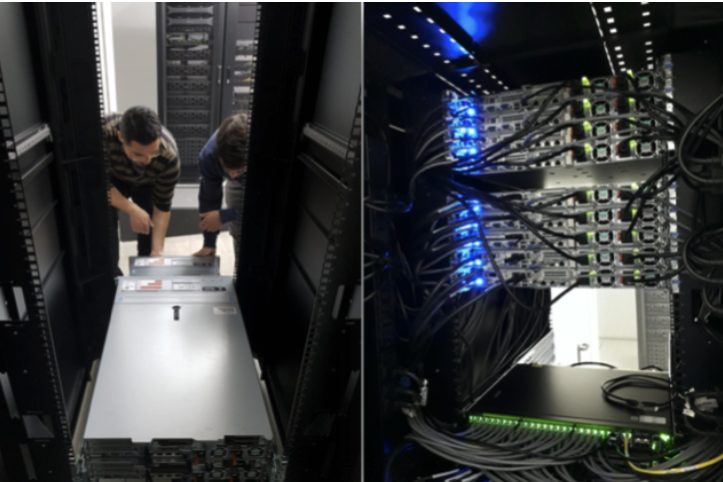
Members of the Spanish SKA team assembling the servers for the Spanish SRC Prototype (2020). Credit: IAA-CSIC
For her part, Lourdes Verdes-Montenegro, a researcher at the IAA-CSIC, coordinator of Spanish participation in SKAO, and head of the espSRC, emphasizes that “SKAO embraces sustainability and open science among its founding principles, and our prototype stands out as a benchmark for implementing both aspects within the SRCNet.” Open science is based on the principle of research reproducibility. According to UNESCO, this approach is increasingly recognized as a fundamental accelerator for achieving the Sustainable Development Goals (SDGs). To this end, it is essential that data, methods, and analytical tools be available to society. “SKAO will change the way science is done: it will no longer be possible to work locally on our computers, and the SRCs will constitute the scientific core of SKAO, providing an environment that fosters and facilitates collaboration between international teams following the principles of open science,” concludes Lourdes Verdes-Montenegro.
Aug 2, 2024 | All, Science, SKA-spain
02/08/2024 – More than 630 participants gathered in Granada to discuss the latest developments in astronomy. The SKA project was extensively discussed, with key presentations on its technological and scientific capabilities, underlining the importance of Spanish collaboration in this global research infrastructure.
From July 15th to 19th, the XVI Scientific Meeting of the Spanish Astronomical Society (SEA, for its acronym in Spanish) was held in Granada, with a record attendance of over 630 participants and more than 400 scientific talks. During this meeting, the latest scientific and technological advances in astronomy and the Spanish participation in major projects and research infrastructures were shared. Among these, the SKA project played a prominent role, as it was the subject of the inaugural plenary lecture, a special session, and also featured in another plenary and talks in various parallel sessions.
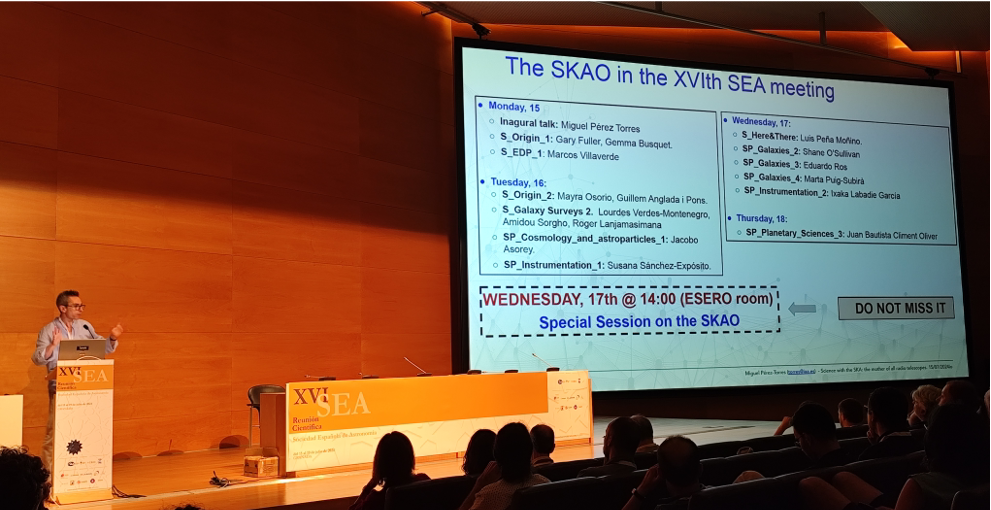
Inaugural plenary lecture “Science with SKA: the mother of all radio telescopes” by Miguel Pérez-Torres (IAA-CSIC)
In the inaugural talk, Miguel Pérez-Torres (IAA-CSIC) discussed the capabilities of SKAO telescopes and the scientific research that can be conducted with them, encouraging all attendees to become part of the SKA community by participating in the Science Working Groups. This talk can be watched in full on the SEA's YouTube channel (link). The special session on SKA focused on the latest developments at the SKA Observatory and its international network of Regional Centres (SRCNet), addressing topics such as: the timeline for the construction of SKAO telescopes, updates on scientific cases, the SKA Science Conference to be held in June 2025, the tools already available to the community, the services offered by the Spanish prototype of SKA Regional Centre at IAA-CSIC (espSRC), and the launch of the first functional version of the SRCNet in early 2025.
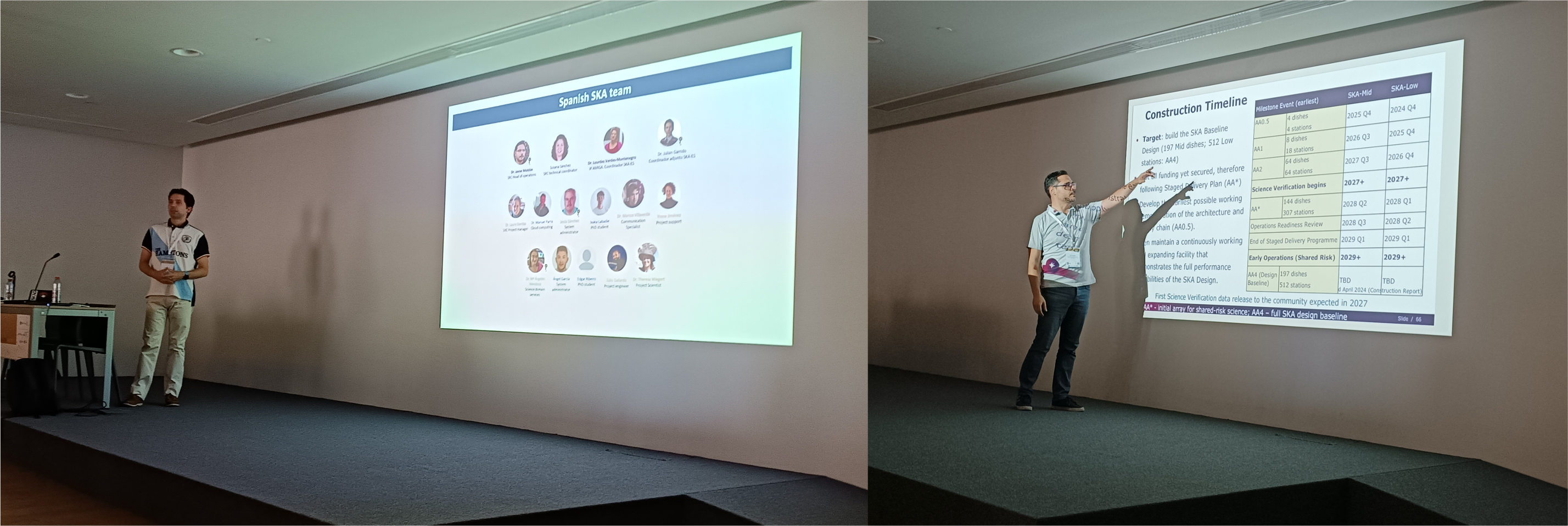
Julián Garrido (IAA-CSIC) and Javier Moldón (IAA-CSIC) during the special session on SKA
The plenary talks on the second day included a presentation by Vanessa Graber (University of Hertfordshire). In this talk, she summarised the work she conducted at the Institute of Space Sciences (ICE-CSIC) on pulsars and long-period radio transients, highlighting observations made with the Murchison Widefield Array, one of the SKAO precursors in Australia. This talk can also be viewed on the SEA's YouTube channel (link).
In the parallel sessions, the SKA project was also discussed from the scientific, technological and science communication aspects. The invited talks by Susana Sánchez (IAA-CSIC) and Lourdes Verdes-Montenegro (IAA-CSIC) were particularly focused on the SKA project. Susana Sánchez discussed Spain's contribution to SRCNet and the TED4SKA project, which aims to reduce the energy consumption of SKA Regional Centres. Lourdes Verdes-Montenegro provided a review of the study of galaxies and their environments using HI observations with SKA precursors and pathfinders.
También se presentaron otras tres charlas sobre observaciones con precursores y pathfinders de SKA: Jacobo Asorey (UCM) habló sobre Cosmología con surveys de ASKAP, Roger Ianjamasimanana (IAA-CSIC) presentó un trabajo sobre el gas en grupos compactos de Hickson realizado con observaciones de MeerKAT y Shane O’Sullivan (UCM) sobre observaciones del medio intergaláctico magnetizado realizadas en los surveys LOTSS de LOFAR y POSSUM de ASKAP.
In the instrumentation and supercomputing session, Ixaka Labadie (IAA-CSIC) presented his research on remote and interactive visualisation of spectral data cubes implemented in the espSRC, which is already being applied to MeerKAT data, a SKA precursor telescope. In a different area, Marcos Villaverde (IAA-CSIC) spoke in the session dedicated to education, outreach, and heritage about the outreach initiatives carried out by SKAO and the role of Open Science in dissemination. It is also worth mentioning a poster by David Alonso-López (UCM) on work conducted within the POSSUM-ASKAP collaboration concerning the magnetised gas in the Shapley supercluster
In addition to all this, SKAO and its telescopes were featured in other talks as a reference for the future. All of this reflects the Spanish community's interest in the SKA project and its science.
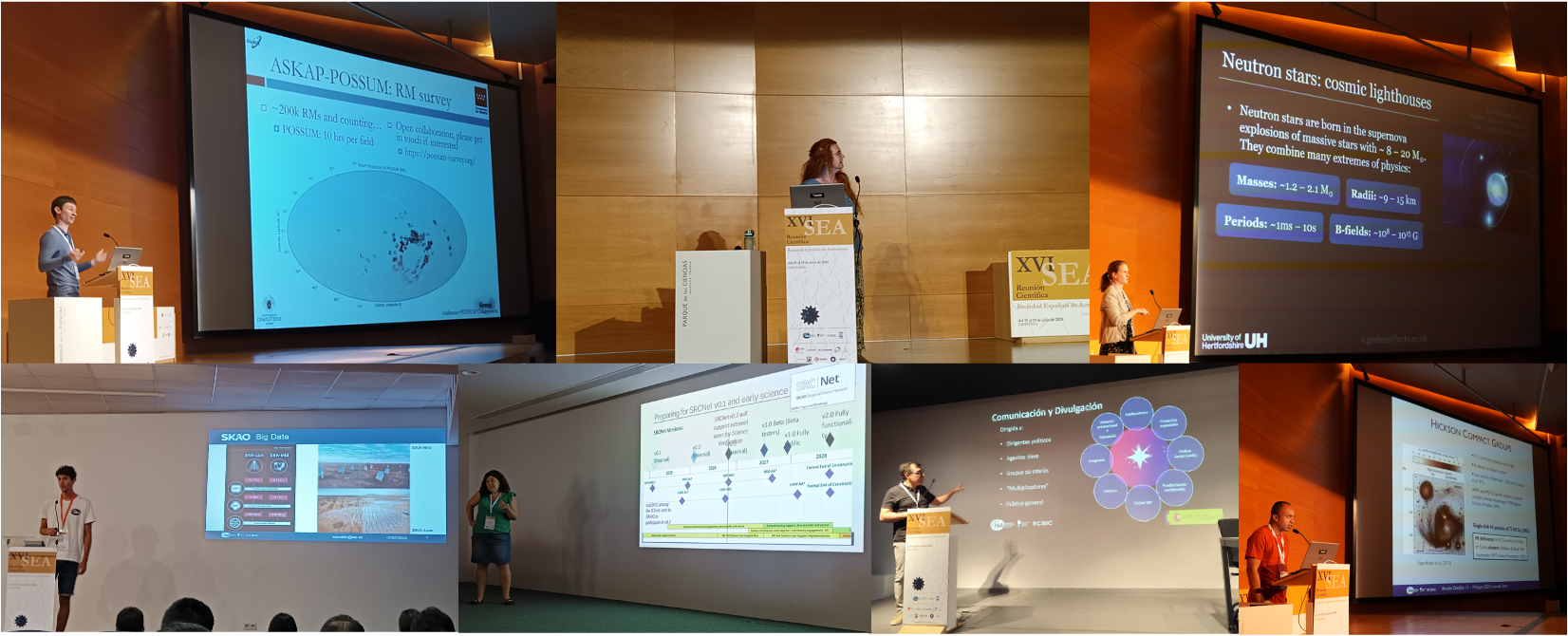
From left to right and from top to bottom: Shane O’Sullivan (UCM), Lourdes Verdes-Montenegro (IAA-CSIC), Vanessa Graber (University of Hertfordshire / ICE-CSIC), Ixaka Labadie (IAA-CSIC), Susana Sánchez (IAA-CSIC), Marcos Villaverde (IAA-CSIC) and Roger Ianjamasimanana (IAA-CSIC)
Jun 22, 2023 | All, SKA-spain, SRCs
22/06/2023 – The emerging era of Big Data is demanding a transformation in the way science is done via a growing push to make scientific research more accessible, a movement known as 'Open Science'. To explore what this means in practice for researchers, the first SKA Open Science School took place in Granada, Spain, from 8-10 May 2023, bringing together 80 participants from 14 countries.
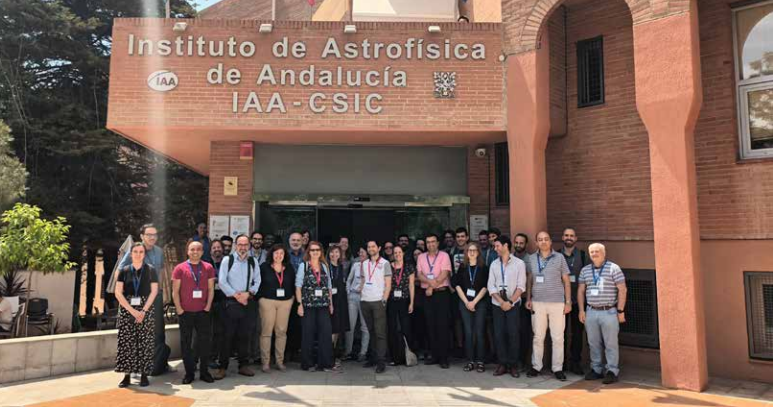
The IAA-CSIC Severo Ochoa Open Science school at the Institute of Astrophysics of Andalusia was organised as a fully hybrid meeting,
with around 50% of its participants attending online. Credit: IAA-CSIC
The hybrid school was endorsed by the SKA Regional Centre partner training programme and co-organised with the SKAO under the IAA-CSIC Severo Ochoa Programme.
Participants ranged from graduate students looking for tips on making their thesis work reproducible (making tools and techniques public so that others – and even the original researchers themselves – can achieve the same results later), to the already Open Science-savvy wanting to learn practical tools. Instructors discussed transitions in science practices with accompanying challenges, and presented practical solutions, including hands-on demos. They covered topics on how to make projects/code portable throughout new versions of software, how to best use containers and science platforms, virtual observatories, setting up citizen science projects, licenses, and more.
Discussions continued between sessions on how to change habits that give quick, publishable results (the “publish-or-perish” mentality) and instead invest the time needed for long-term open and reproducible science, including how Open Science work can be appreciated by employers. As Prof. Eva Mendez of Charles III University of Madrid (UC3M) asked: “Are we prepared for a new research evaluation?”
SKAO Scientist Dr Philippa Hartley shared the new SKAO statement on Open Science, including its mission and what Open Science will do for the SKA, and the IAA’s Dr Lourdes Verdes-Montenegro, coordinator of the Spanish participation in the SKA, noted that “large scientific infrastructures have an ethical role and a practical need in Open Science”.
Sessions from the Open Science school are publicly available
on the school webpage.