Feb 27, 2025 | All, SKA-spain, SRCs
27/02/2025 – The Spanish prototype of the SKA Regional Centre, under development by the IAA-CSIC, becomes the first centre to successfully complete its integration into SRCNet0.1, the first operational version of the international network that will constitute the scientific heart of the SKA Observatory (SKAO).
SKAO is an international organization building two state-of-the-art radio telescopes: SKA-Low in Australia, with over 130,000 dipole antennas for transmitting and receiving radio waves, and SKA-Mid in South Africa, with 197 parabolic antennas, each 15 meters in diameter. When the observatory's telescopes are operational, they will generate over 700 million gigabytes of data annually. All this data will be housed at SKA Regional Centres (SRCs), where it can also be accessed remotely. The various SRCs, distributed around the world, will be interconnected, forming a global network: SRCNet.
Last Monday, February 24, it was announced that the Spanish prototype of the SKA Regional Center, being developed at the Institute of Astrophysics of Andalusia (IAA-CSIC), was the first to complete the deployment and integration of the services required to become part of SRCNet0.1. This initial operational version of the international network will be fundamental for the functioning of the SKA Observatory (SKAO).
The Spanish prototype of SRC, called espSRC, is one of 17 national initiatives contributing to the development of SRCNet. “We have been working on this project since 2019, demonstrating our firm commitment to the development of SRCNet as a collaborative platform. Being the first center to deploy the necessary services to become an SRCNet0.1 node is a result of this commitment and close collaboration with the other international groups involved,” says Susana Sánchez-Expósito, technical coordinator of espSRC at the IAA-CSIC. “We currently have a fully functional system that has served more than 30 scientific projects in different branches of astrophysics,” she adds. Isabel Márquez, scientific director of the Severo Ochoa program at the IAA-CSIC, also highlights: “It is this multidisciplinary approach that makes the SRC prototype one of the key pillars, and a cross-cutting element in our scientific strategy, funded by our Severo Ochoa excellence project. Having an infrastructure of this level at our center positions Andalusia and Spain within the international SKA collaboration.”
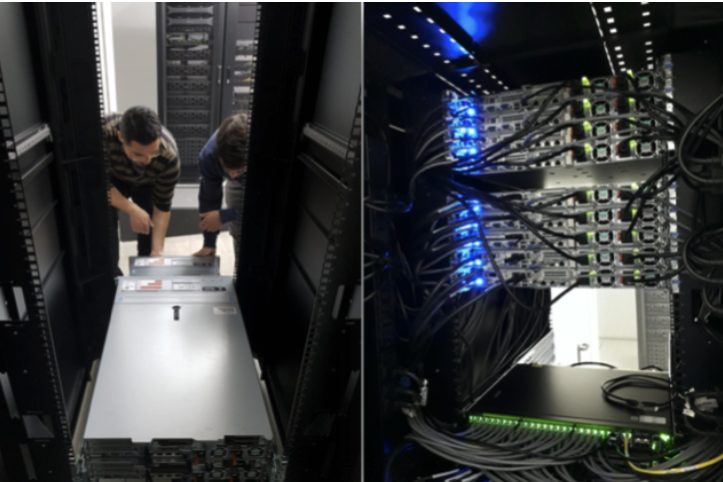
Members of the Spanish SKA team assembling the servers for the Spanish SRC Prototype (2020). Credit: IAA-CSIC
For her part, Lourdes Verdes-Montenegro, a researcher at the IAA-CSIC, coordinator of Spanish participation in SKAO, and head of the espSRC, emphasizes that “SKAO embraces sustainability and open science among its founding principles, and our prototype stands out as a benchmark for implementing both aspects within the SRCNet.” Open science is based on the principle of research reproducibility. According to UNESCO, this approach is increasingly recognized as a fundamental accelerator for achieving the Sustainable Development Goals (SDGs). To this end, it is essential that data, methods, and analytical tools be available to society. “SKAO will change the way science is done: it will no longer be possible to work locally on our computers, and the SRCs will constitute the scientific core of SKAO, providing an environment that fosters and facilitates collaboration between international teams following the principles of open science,” concludes Lourdes Verdes-Montenegro.
Jun 22, 2023 | All, SKA-spain, SRCs
22/06/2023 – The emerging era of Big Data is demanding a transformation in the way science is done via a growing push to make scientific research more accessible, a movement known as 'Open Science'. To explore what this means in practice for researchers, the first SKA Open Science School took place in Granada, Spain, from 8-10 May 2023, bringing together 80 participants from 14 countries.
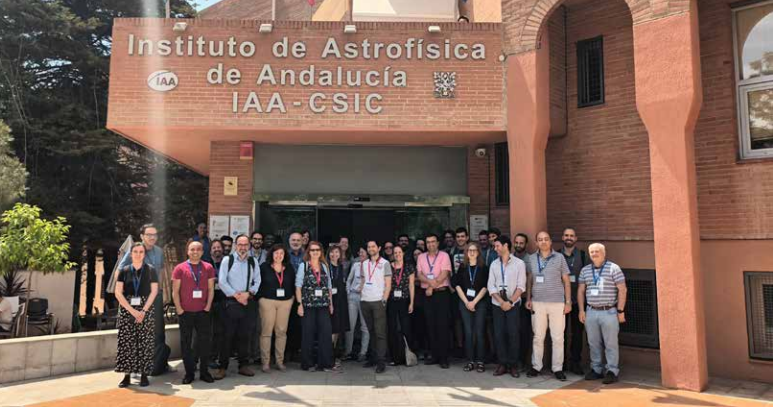
The IAA-CSIC Severo Ochoa Open Science school at the Institute of Astrophysics of Andalusia was organised as a fully hybrid meeting,
with around 50% of its participants attending online. Credit: IAA-CSIC
The hybrid school was endorsed by the SKA Regional Centre partner training programme and co-organised with the SKAO under the IAA-CSIC Severo Ochoa Programme.
Participants ranged from graduate students looking for tips on making their thesis work reproducible (making tools and techniques public so that others – and even the original researchers themselves – can achieve the same results later), to the already Open Science-savvy wanting to learn practical tools. Instructors discussed transitions in science practices with accompanying challenges, and presented practical solutions, including hands-on demos. They covered topics on how to make projects/code portable throughout new versions of software, how to best use containers and science platforms, virtual observatories, setting up citizen science projects, licenses, and more.
Discussions continued between sessions on how to change habits that give quick, publishable results (the “publish-or-perish” mentality) and instead invest the time needed for long-term open and reproducible science, including how Open Science work can be appreciated by employers. As Prof. Eva Mendez of Charles III University of Madrid (UC3M) asked: “Are we prepared for a new research evaluation?”
SKAO Scientist Dr Philippa Hartley shared the new SKAO statement on Open Science, including its mission and what Open Science will do for the SKA, and the IAA’s Dr Lourdes Verdes-Montenegro, coordinator of the Spanish participation in the SKA, noted that “large scientific infrastructures have an ethical role and a practical need in Open Science”.
Sessions from the Open Science school are publicly available
on the school webpage.
Oct 13, 2017 | All, SKA-spain, SRCs
Con motivo de la celebración en el Instituto de Astrofísica de Andalucía (IAA-CSIC) de una reunión del proyecto H2020 AENEAS, para el desarrollo de una Red Europea de Centros de Datos del Square Kilometre Array, se celebrarán en el IAA varias reuniones más relacionadas con el proyecto SKA.
Será una semana muy interesante para los participantes de todas las reuniones, ya que se reunirán en Granada miembros del Grupo de Coordinación de Centros Regionales del SKA, miembros del proyecto SKA-Link y miembros del proyecto AENEAS.
Como parte de las jornadas, el investigador principal del proyecto AENEAS dará una conferencia sobre cómo la Red de Centros Regionales del SKA constituirá una plataforma para realizar la ciencia del SKA y la astronomía de forma global. Además, el jefe de la red de computación del Gran Colisionador de Hadrones (LHC) hablará sobre el reciente acuerdo de colaboración firmado entre el SKA y el CERN (Organización Europea para la Investigación Nuclear).
Toda la información sobre las reuniones que tendrán lugar la puedes encontrar en la web del IAA-CSIC