Jan 27, 2026 | All, Science, SKAO
27/01/2026 – The SKA Observatory’s growing telescope array in South Africa, SKA-Mid, has achieved “first fringes” using two of its dishes, a milestone that demonstrates it is operating as an interferometer for the first time.
“This is the first true test that all our systems are working together, and that the SKA-Mid telescope is alive as a scientific instrument,” said SKAO Director-General Prof. Philip Diamond.
“Having each dish observe the sky individually is an achievement, but having them operate in concert as one telescope is a much bigger technical challenge, and our teams have now achieved that milestone.”
SKA-Mid, like its counterpart SKA-Low in Australia, is an array where many individual antennas are connected by optical fibre to act like one much larger telescope, equivalent in size to the distance between its furthest antennas. "Fringes” are obtained when signals received by two or more antennas are combined successfully.
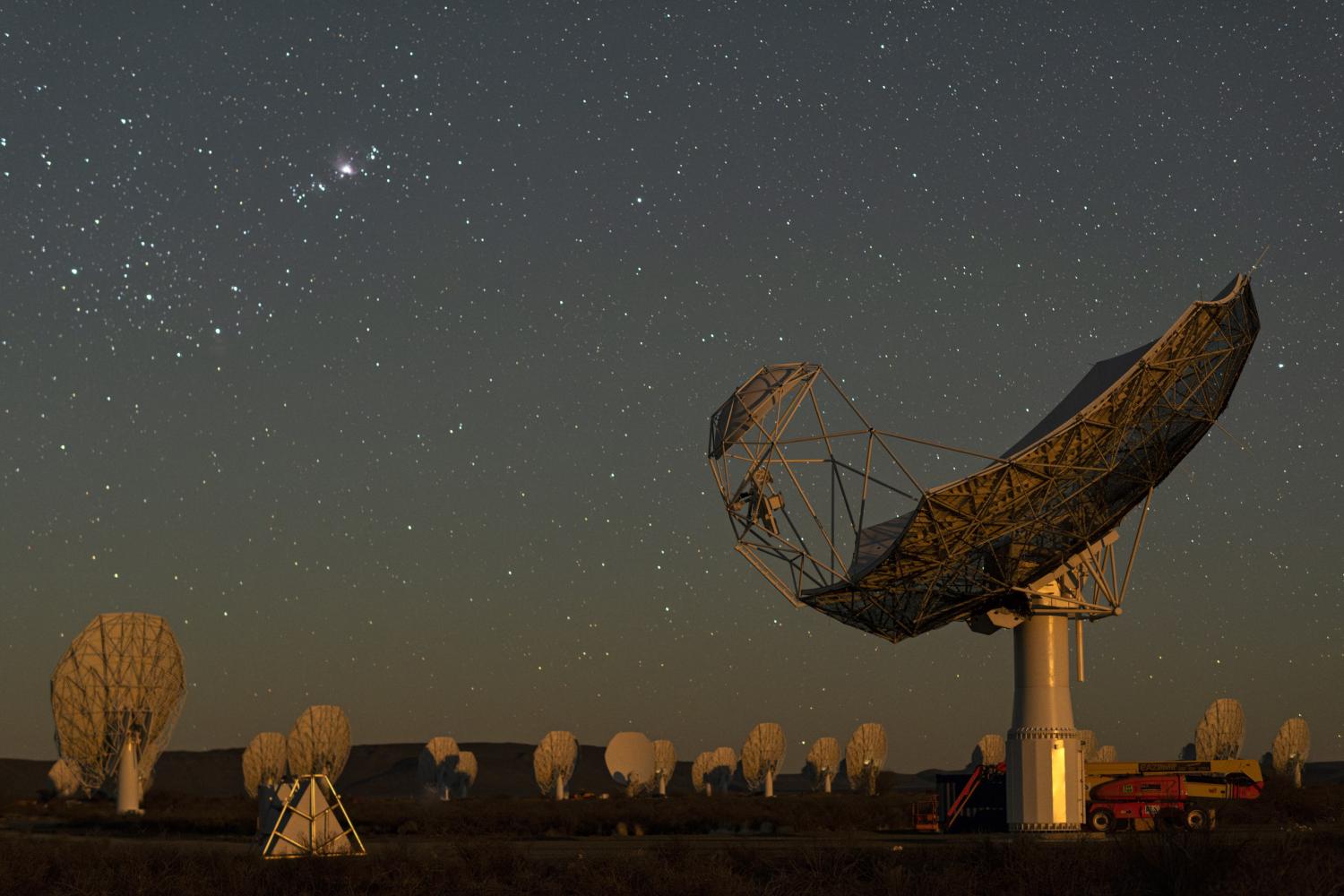
One of the seven SKA-Mid dishes now constructed on site in South Africa's Northern Cape, with SARAO's MeerKAT radio telescope in the background. Credit: SKAO/Max Alexander.
Two of SKA-Mid's 15m-diameter dishes were used together to achieve the result, observing a radio galaxy estimated to be around 2.6 billion light years away.
“This source has been well studied so we know what the signal should look like, and that’s what we observed with this first fringes result. It confirms that all our hardware and software systems are working as we designed them to do, giving us confidence as we begin to commission the telescope,” said Dr Betsey Adams, SKA-Mid Commissioning Scientist.
“That includes seeing that the dishes can track across the sky in a coordinated way under the control of the telescope manager software, the receivers are being cooled to the required temperature of minus 250°C, the synchronisation and timing system is accurately timing signals from the different dishes to a billionth of a second, and the correlator is correctly processing and aligning the data.”
SKA-Mid now has seven dish structures assembled on site in the Northern Cape, with a further 12 on their way from the manufacturers CETC54 in China. When complete the telescope will comprise 197 dishes, including the integration of the existing MeerKAT radio telescope built and operated by the South African Radio Astronomy Observatory (SARAO). The hardware and software for the SKA telescopes are being developed in the Observatory's member states, including Spain. Specifically, the time signal distribution and synchronisation system, which is key to performing interferometry. This technology has been developed by the Spanish company Safran Electronics & Defence Spain, based in Granada, which is also responsible for the same system for the SKA-Low telescope in Australia.
“Starting the year with this news is a huge boost for the teams that have worked extremely hard to see it happen, including SKAO and SARAO colleagues, and our global and local partners who are contributing to the infrastructure, hardware and software for SKA-Mid,” said Ben Lewis, SKA-Mid Senior Project Manager.
“With all we’ve learned from these months building up to first fringes, we’re in a strong position to achieve our next milestone – the first image from a four-dish array within the next few months – and then to see SKA-Mid gradually grow in size and capabilities from there.”
Across the ocean in Australia, the SKA-Low telescope continues to grow at pace. Around 70 antenna stations, each comprising 256 antennas, have now been installed at Inyarrimanha Ilgari Bundara, the CSIRO Murchison Radio-astronomy Observatory on Wajarri Yamaji Country in Western Australia. Last year its first image was released, using an early version of the telescope comprising four connected stations – 1,024 antennas – or less than 1% of the complete telescope.
As work continues to commission stations and integrate them into the array, planning is underway for the start of science verification activities with SKA-Low in 2027, when the first data will be released to the community for test observations.
Mar 17, 2025 | All, Science
March 17, 2025 – The first image from the SKA-Low radio telescope was released today. SKA-Low is part of the SKA Observatory (SKAO) and is located in Australia. This marks a significant milestone in SKAO's mission to provide an unprecedented view of our universe.
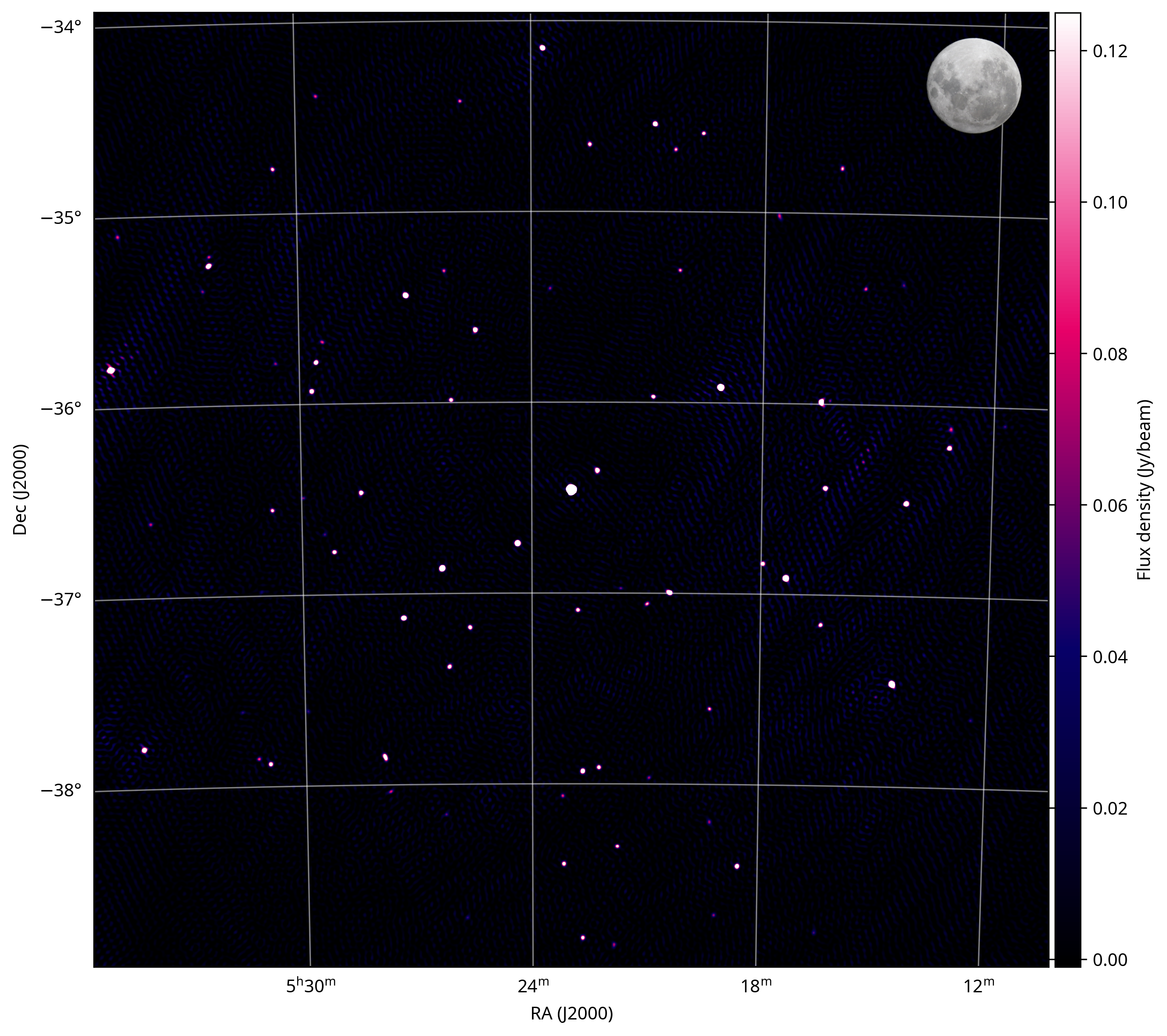
The first image using four stations of SKA-Low. The full moon in the upper right corner is shown for image size reference. Credit: SKAO
The image covers an area of the sky approximately 25 square degrees in size, equivalent to about 100 full moons. It displays 85 of the brightest known galaxies in that region, all of which contain supermassive black holes. The image was obtained with an early version of the SKA-Low telescope, one of two telescopes being built by SKAO. This early version of SKA-Low consists of just 1,000 of the planned 131,000 antennas. Once completed, the telescope will be able to reveal many more objects; scientists estimate it will be able to detect more than 600,000 galaxies in the same region of the sky.
SKAO is currently building two radio telescopes: SKA-Low in Western Australia and SKA-Mid in the Northern Cape Province of South Africa. The telescopes are arrays of 15-meter parabolic antennas (SKA-Mid) and dipole antennas (SKA-Low), spread over large distances. Two Spanish companies, Safran Electronics & Defense Spain and EMITE, are playing a key role in the construction of SKA-Low, providing high-precision synchronization systems between the antennas and equipment for testing and validating electronic components. "Synchronizing the signals from the different antennas is crucial for combining them correctly. Furthermore, to avoid interference, it is necessary to test that all electronic components do not generate noise in radio waves that could affect the signal from the astronomical objects being observed," explains Dr. Julián Garrido, deputy technology coordinator at SKA-Spain, adding: "For this same reason, the telescopes are being built in remote, sparsely populated locations, minimising human-caused interference."
SKA-Low is being built at Inyarrimanha Ilgari Bundara, the CSIRO Murchison Radio Astronomy Observatory, which is located on the lands of the Wajarri Yamaji Aboriginal people, the traditional owners and native land title holders. The location's Aboriginal name, Inyarrimanha Ilgari Bundara, means "sharing the sky and stars", and reflects the commitment and collaboration between SKAO and the Indigenous peoples and cultures who inhabit the lands where its telescopes are being built.
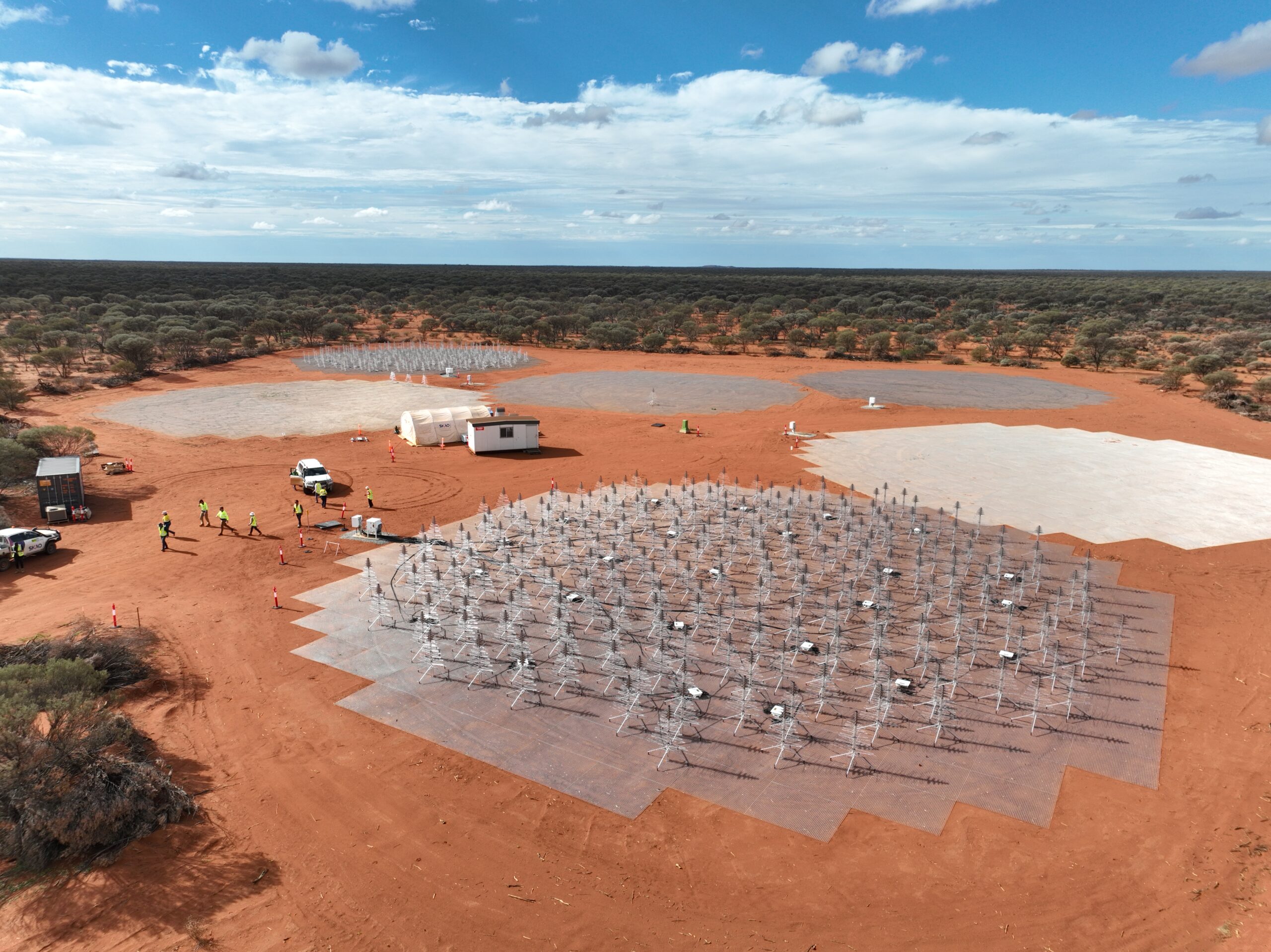
Drone image of SKA-Low's S8 cluster with two stations completed from June 2024. Credit: SKAO
The acquisition of this image has verified the telescope's operation and capabilities. Professor Philip Diamond, Director General of the SKAO, said the image marks the observatory's debut as a scientific facility. "With this image we see the promise of the SKA Observatory as it opens its eyes to the Universe," said Professor Diamond. "This first image is a critical step for the Observatory, and for the astronomy community; we are demonstrating that the system as a whole is working. As the telescopes grow, and more stations and dishes come online, we’ll see the images improve in leaps and bounds and start to realise the full power of the SKAO."
The SKAO telescopes are being built in phases, with components sourced from SKAO member countries around the world. Dr. Lourdes Verdes-Montenegro, coordinator of Spain's participation in the SKAO, highlighted the international nature of the observatory: "This milestone has been possible thanks to an international collaboration between scientists and engineers from academia and industry. Sixteen countries from five continents are participating in the SKA project, and the impact it is already having and will have will be global thanks to SKAO's commitment to the scientific community and international society as a whole."
The Spanish participation in the SKAO is funded by the Ministry of Science, Innovation and Universities, with the Andalusian Institute of Astrophysics (IAA-CSIC) responsible for the national scientific and technical coordination of the project.
This animation shows the various stages of deployment of the SKA-Low telescope over the coming years, and the images it is expected to produce of the same area of the sky. Credit: SKAO
Links of interest
Associated multimedia materials https://skao.canto.global/b/LTFMH
SKAO press release: https://www.skao.int/en/news/621/ska-low-first-glimpse-universe
Jan 23, 2025 | All, Science, SKAO
23/01/2025 - A new era in astrophysics: Preparing for early science with the SKAO
Görlitz, Germany, 16-20 June, 2025
Abstract deadline: February 7, 2025
Registration is now open, early reduced-rate registration closes March 31.
More information and registration:
https://www.skao.int/en/science-users/skao-science-meeting-2025
Taking place just two years before the SKA telescopes will be tested on the first community-chosen targets, the meeting will bring together scientists from across the globe to discuss and collaborate on the cutting-edge science opportunities that the SKAO will provide in its early years of operations. Online participation will be supported for the whole week for those unable to attend in person.
Full details about the meeting are available at the #SKAOsci2025 website. #SKAOsci2025.
Jan 23, 2025 | All, Science, SKAO
Note that the SKAO White Book early draft deadline has been adjusted, and instead there is a general deadline for chapter submissions of September 2025,whereupon a peer review process will commence.
Chapters will have a maximum length of 8 pages. More info, latex templates, etc, available here: https://www.skao.int/en/science-users/557/advancing-astrophysics-ii
Jan 23, 2025 | All, Science
22/01/2025 - A radio transient with the longest period yet seen, 2.9 hrs, was discovered by a team including Nanda Rea of ICE-CSIC and published in December 2024.
The team found the transient in low-frequency archival data from the SKAO precursor Murchison Widefield Array (MWA). Such long-period radio transients are a fairly new area of research and it is challenging to determine how the signals are generated. In this case, the team managed to find the probable source for the energy bursts, using another SKA precursor, MeerKAT, and optical SOAR observatory, and determine that the optical counterpart is a cool M3 dwarf star. This means that the signal is not due to a magnetar, but more likely is generated in a dwarf binary system scenario.
Read more:
ICE-CSIC press release
ICRAR press release
Paper: Hurley-Walker et al., 2025
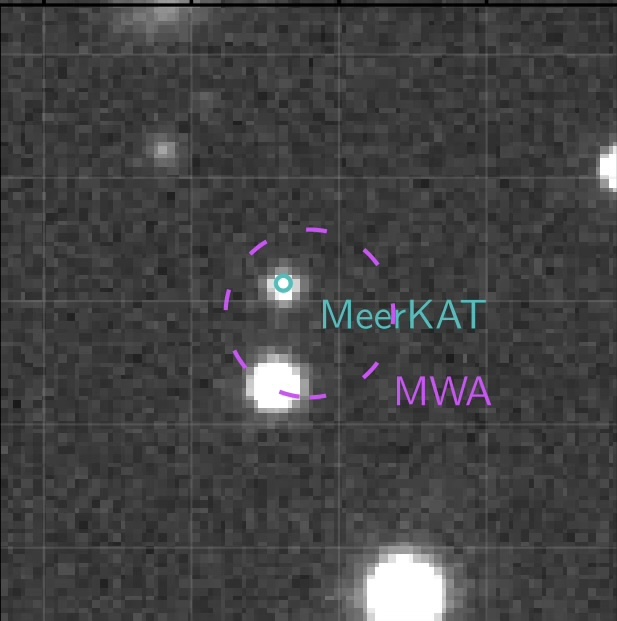
Using 2 SKAO precursors, the team could trace the 2.9 hr long-period transient radio source to a specific object and measure its counterpart in optical to find an M3 dwarf star. Image credit: Hurley-Walker at al, 2024..
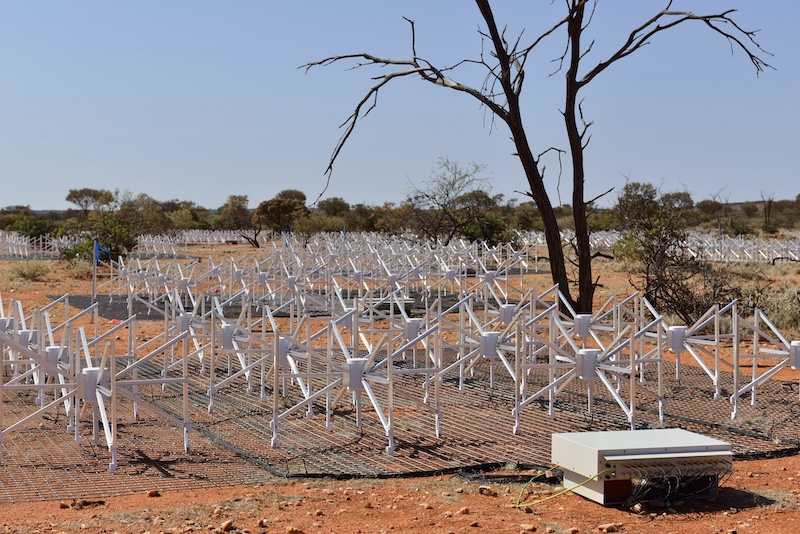
The team found the radio signal in archival data from the Murchison Widefield Array radio telescope, an SKAO precursor. Image credit: ICRAR/Curtin.
Sep 12, 2024 | All, Science, SKAO
01/09/2024 – El Observatorio SKA abre a la comunidad científica internacional la convocatoria para contribuir a la nueva edición del libro de ciencia SKA hasta el próximo 30 de septiembre.
El próximo año, durante la Reunión General de Ciencia del Observatorio SKA (SKAO) que se celebrará del 16 al 20 de junio, se cumplirá una década desde la publicación del libro de ciencia de SKA «Advancing Astrophysics with the Square Kilometre Array«. Este libro, escrito por la propia comunidad internacional, documenta los avances científicos que serán posibles gracias a los telescopios del SKA. En estos diez años, el diseño se ha cerrado, la construcción ha comenzado y la Organización SKA se ha transformado en un observatorio en forma de organización intergubernamental que abarca cinco continentes y ambos hemisferios.
Durante este tiempo, las observaciones realizadas con los telescopios precursores y pathfinders de SKA han arrojado nueva luz sobre enigmas científicos ya existentes y han descubierto nuevos fenómenos a la espera de una respuesta. Ahora, el SKAO está listo para comenzar las primeras pruebas para su puesta en marcha, con lo que las actividades de observación irán incrementando rápidamente. Los primeros datos de verificación científica estarán disponibles públicamente para la comunidad en 2027, y las operaciones con ambos telescopios comenzarán en 2029.
Credit: SKA Observatory
En este momento crítico, SKAO invita a la comunidad científica a contribuir a redactar una nueva versión del libro de ciencia del SKAO. El objetivo es proporcionar una cobertura actualizada de las preguntas científicas que abordarán los telescopios del SKA que esté redactada sobre la base de un conjunto maduro de especificaciones y con una variedad de herramientas y documentos disponibles basados en trabajos de diseño detallados y características del entorno de los telescopios del SKA.
El SKAO ha puesto a disposición de la comunidad científica una página donde se encuentran los detalles sobre la presentación de las expresiones de interés en contribuir con un capítulo del libro y sobre la Reunión General de Ciencia del SKAO 2025. Desde el equipo de coordinación de SKA-Spain, animamos a la comunidad española, especialmente al personal que se encuentra en etapas tempranas de sus carreras, a contribuir al libro, ya sea actualizando casos científicos existentes o incluyendo nuevos casos no cubiertos anteriormente. La convocatoria de Expresiones de Interés se cerrará el 30 de septiembre de 2024, serán revisadas por los presidentes de los Science Working Groups de SKA y se invitará a todas las ideas científicas viables a prepararse como capítulos para el libro.
Esta iniciativa presenta una oportunidad única para la comunidad científica española de influir en la dirección de la investigación astronómica internacional de los próximos años. España, como país miembro de SKAO, tendrá acceso tanto a los Key Science Projects (KSPs – proyectos de legado que ocuparan el ~ 70% del tiempo en los primeros 5 años de operaciones) como al tiempo asignado para propuestas de IP, que será proporcional al porcentaje de participación de cada país miembro. Al actualizar y añadir nuevas ideas al libro, la comunidad española podrá contribuir a maximizar el potencial científico de los telescopios del SKA y asegurar que éstos aborden el interés científico nacional, con el objetivo de mantener a la comunidad a la vanguardia de los descubrimientos astronómicos.
En conclusión, la nueva edición del libro de ciencia SKA será una guía esencial para los futuros estudios astronómicos y una plataforma para la colaboración internacional. Desde SKA-Spain, invitamos a todos los interesados a participar en esta emocionante aventura científica y a contribuir con sus conocimientos y experiencias para hacer de esta publicación un recurso valioso y actualizado para la comunidad científica global.