Jun 25, 2025 | All, Industry
25/06/2025 – Spain strengthens its strategic role in the SKA Observatory: EOSOL and COMPOXI successfully complete the Detailed Design Review of the SKA-Mid telescope sub-reflectors.
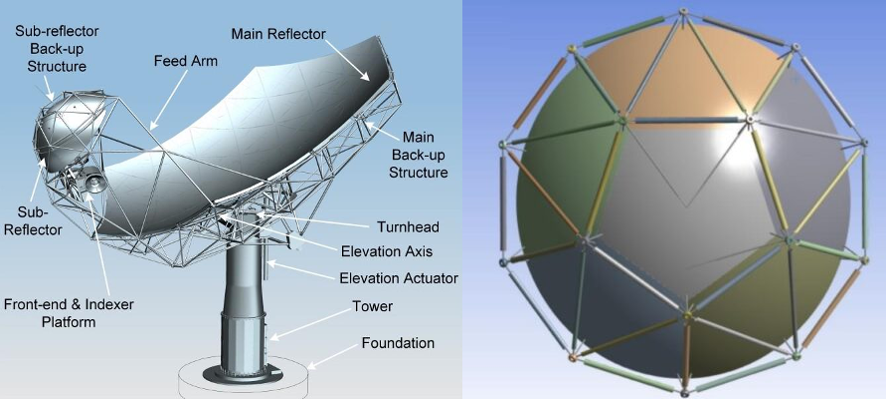
3D models of a SKA-Mid antenna and its subreflector (Credits: SKAO and EOSOL)
The coordination team for Spain’s participation in the SKA project is pleased to announce that the Spanish companies EOSOL and COMPOXI have successfully passed the Detailed Design Review (DDR) for the construction project of the sub-reflectors for the SKA-Mid radio telescope. This milestone represents a decisive step in Spain’s contribution to one of the most ambitious and large-scale scientific engineering projects of the 21st century.
The successful completion of this phase validates the developed technical design and paves the way for the manufacturing stage of the 44 sub-reflectors to be integrated into the SKA-Mid antenna array, currently under construction in South Africa. This achievement is the result of several months of close collaboration between EOSOL, COMPOXI, and the technical team at the SKA Observatory, and it highlights the advanced technological capabilities of the Spanish industrial sector.
The sub-reflectors—a critical component responsible for directing incoming signals to the receivers—have a diameter of 4.5 meters and are made of composite materials with a metallized surface to ensure both mechanical stability and demanding electromagnetic performance. Each unit comprises over 100 individual parts, including six main panels and three extensions, all of which must be assembled with high precision.
We emphasize the strong collaboration between COMPOXI, a company specialized in the design and manufacturing of composite structures, and EOSOL, a leading provider of engineering services for strategic sectors. This kind of synergy exemplifies the ability of the Spanish industrial sector to make substantial and effective contributions to large-scale international scientific infrastructures.
The SKA Observatory, with core sites in South Africa and Australia, will host the most advanced radio telescopes on Earth, enabling the global scientific community to explore the Universe with unprecedented resolution and scope. Spain’s active participation—at the institutional, scientific, and industrial levels—reinforces its role as a strategic partner within this intergovernmental organization.
It is worth noting that this contract has been partially funded by the European Union through the NextGenerationEU programme, managed by the Spanish Ministry of Science, Innovation and Universities. This reflects the significant impact of public investment in research and innovation on the international visibility and competitiveness of Spain’s technological capabilities.
About Grupo EOSOL:
The EOSOL Group is a global engineering, monitoring and technical support services company with experience in more than 40 countries around the world. The aerospace division develops antennas and RF components for the space, defence and scientific sectors. We provide our customers with high-performance antenna solutions. The division covers all tasks related to the study and implementation of antennas and RF components (feasibility study, detailed design, prototyping, qualification and production).
For more information, please visit their website.
About Compoxi
Compoxi is a leading company in the design and production of composite structures. Compoxi combines advanced design, analysis, qualification and prototyping capabilities with industrial means that enable it to carry out serial production. Compoxi's portfolio encompasses the design and production of primary structures for satellites and launchers for the space sector, structural components for aeroplanes, helicopters and UAVs for the aeronautical sector and critical elements for scientific and industrial structures.
For more information, please visit their website.
May 29, 2025 | All, SKA-spain
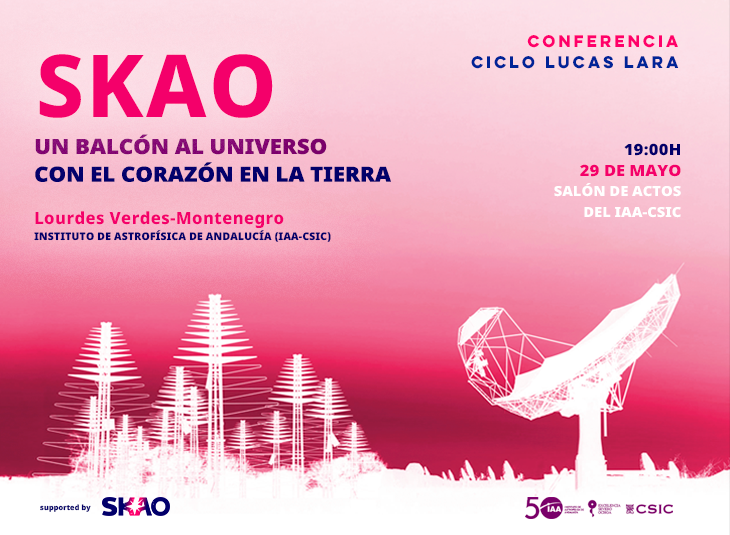
29/05/2025 – The SKAO, a balcony to the Universe with its heart on Earth 05/29/2025 – SKAO, a balcony to the Universe with its heart on Earth, is the title of a public talk in the Lucas Lara lecture series, which will take place on Thursday, May 29 at 7:00 p.m. in the IAA-CSIC Auditorium, Granada, Spain.
The speaker is Lourdes Verdes-Montenegro, who has coordinated Spanish participation in this project since its inception. This is a great opportunity to learn how a large astronomical observational facility, with unprecedented sensitivity and complexity, is conceived, built, and organised. Also, to learn about the construction of these telescopes in remote regions of South Africa and Australia.
In this talk, we'll learn about the latest developments and Spain's participation in the project. We'll also learn about the status of the SKA International Network of Regional Centres, for which one node is being developed in Spain. These centres are essential for the community to access the vast amount of data the telescopes will generate and to benefit from tools, technical support, and specialised training.
From this point on, we will open a window to the lesser-known dimensions of SKAO: the challenge of interference caused by mega-satellite constellations, cooperation with Africa and Indigenous tribes in Australia, Open Science, respect for the environment, and the creation of opportunities beyond science. This is an invitation to observe the Universe with the most advanced technology... and with your feet firmly on the ground.
Poster:
Mar 17, 2025 | All, Science
March 17, 2025 – The first image from the SKA-Low radio telescope was released today. SKA-Low is part of the SKA Observatory (SKAO) and is located in Australia. This marks a significant milestone in SKAO's mission to provide an unprecedented view of our universe.
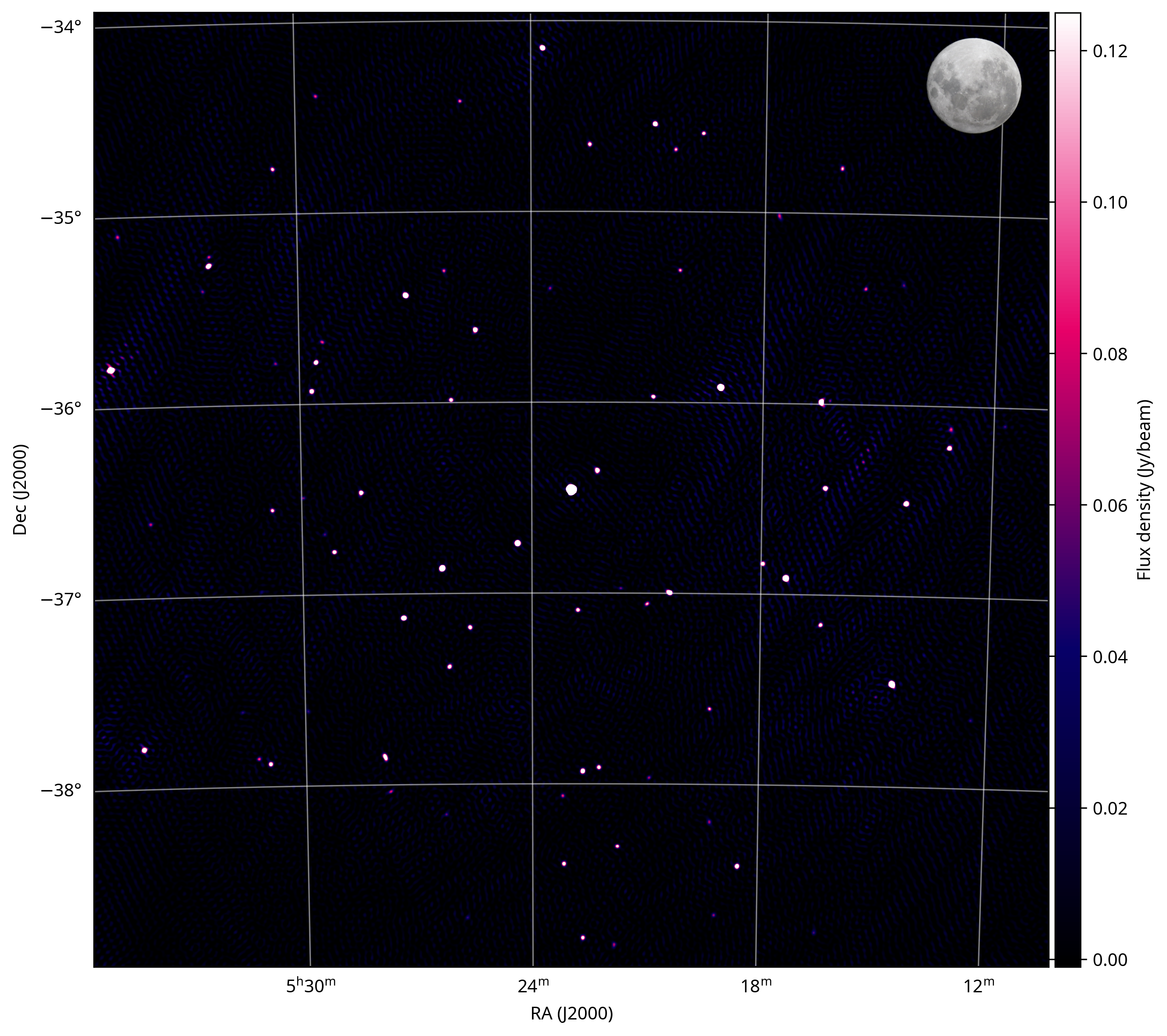
The first image using four stations of SKA-Low. The full moon in the upper right corner is shown for image size reference. Credit: SKAO
The image covers an area of the sky approximately 25 square degrees in size, equivalent to about 100 full moons. It displays 85 of the brightest known galaxies in that region, all of which contain supermassive black holes. The image was obtained with an early version of the SKA-Low telescope, one of two telescopes being built by SKAO. This early version of SKA-Low consists of just 1,000 of the planned 131,000 antennas. Once completed, the telescope will be able to reveal many more objects; scientists estimate it will be able to detect more than 600,000 galaxies in the same region of the sky.
SKAO is currently building two radio telescopes: SKA-Low in Western Australia and SKA-Mid in the Northern Cape Province of South Africa. The telescopes are arrays of 15-meter parabolic antennas (SKA-Mid) and dipole antennas (SKA-Low), spread over large distances. Two Spanish companies, Safran Electronics & Defense Spain and EMITE, are playing a key role in the construction of SKA-Low, providing high-precision synchronization systems between the antennas and equipment for testing and validating electronic components. "Synchronizing the signals from the different antennas is crucial for combining them correctly. Furthermore, to avoid interference, it is necessary to test that all electronic components do not generate noise in radio waves that could affect the signal from the astronomical objects being observed," explains Dr. Julián Garrido, deputy technology coordinator at SKA-Spain, adding: "For this same reason, the telescopes are being built in remote, sparsely populated locations, minimising human-caused interference."
SKA-Low is being built at Inyarrimanha Ilgari Bundara, the CSIRO Murchison Radio Astronomy Observatory, which is located on the lands of the Wajarri Yamaji Aboriginal people, the traditional owners and native land title holders. The location's Aboriginal name, Inyarrimanha Ilgari Bundara, means "sharing the sky and stars", and reflects the commitment and collaboration between SKAO and the Indigenous peoples and cultures who inhabit the lands where its telescopes are being built.
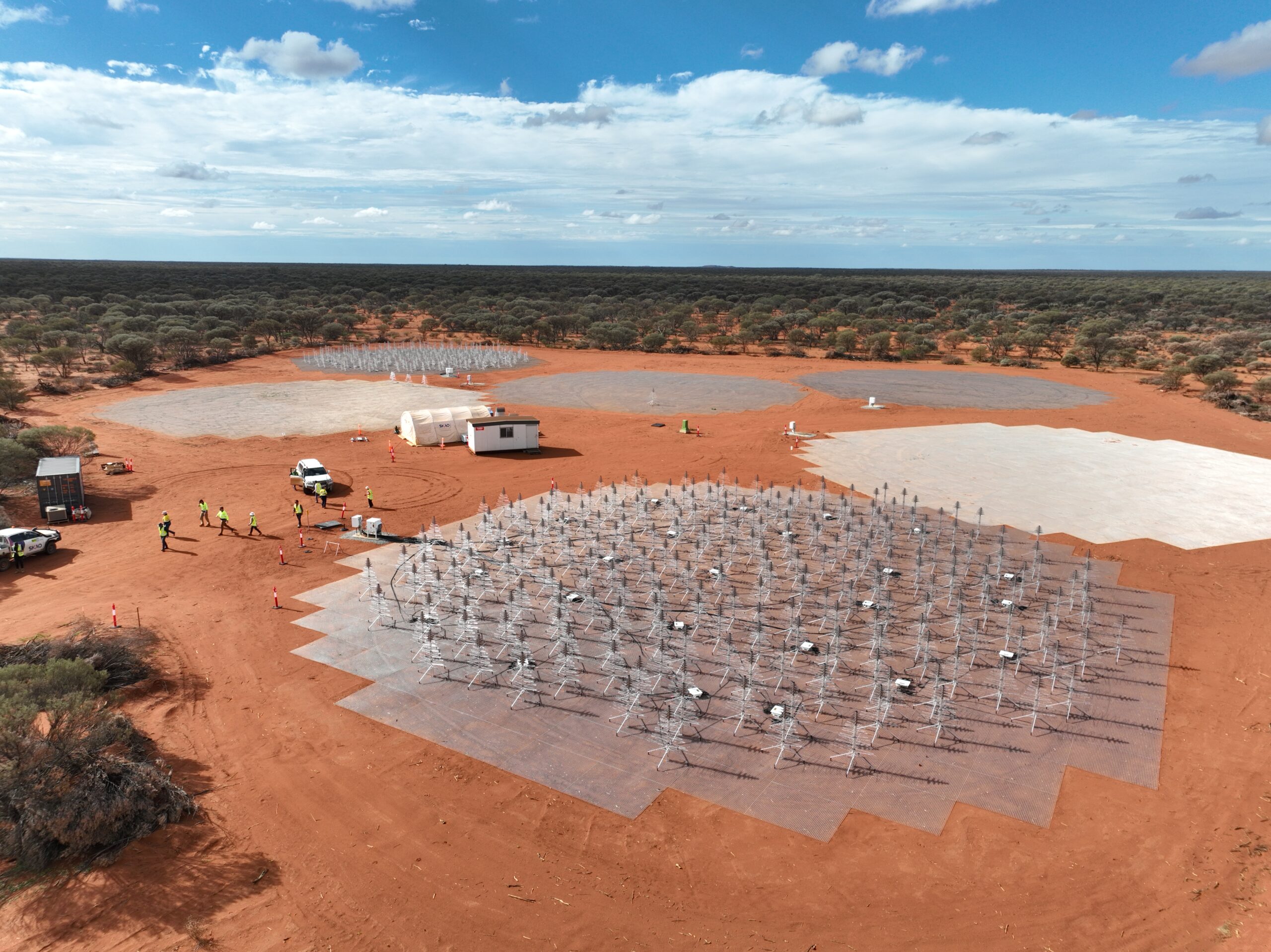
Drone image of SKA-Low's S8 cluster with two stations completed from June 2024. Credit: SKAO
The acquisition of this image has verified the telescope's operation and capabilities. Professor Philip Diamond, Director General of the SKAO, said the image marks the observatory's debut as a scientific facility. "With this image we see the promise of the SKA Observatory as it opens its eyes to the Universe," said Professor Diamond. "This first image is a critical step for the Observatory, and for the astronomy community; we are demonstrating that the system as a whole is working. As the telescopes grow, and more stations and dishes come online, we’ll see the images improve in leaps and bounds and start to realise the full power of the SKAO."
The SKAO telescopes are being built in phases, with components sourced from SKAO member countries around the world. Dr. Lourdes Verdes-Montenegro, coordinator of Spain's participation in the SKAO, highlighted the international nature of the observatory: "This milestone has been possible thanks to an international collaboration between scientists and engineers from academia and industry. Sixteen countries from five continents are participating in the SKA project, and the impact it is already having and will have will be global thanks to SKAO's commitment to the scientific community and international society as a whole."
The Spanish participation in the SKAO is funded by the Ministry of Science, Innovation and Universities, with the Andalusian Institute of Astrophysics (IAA-CSIC) responsible for the national scientific and technical coordination of the project.
This animation shows the various stages of deployment of the SKA-Low telescope over the coming years, and the images it is expected to produce of the same area of the sky. Credit: SKAO
Links of interest
Associated multimedia materials https://skao.canto.global/b/LTFMH
SKAO press release: https://www.skao.int/en/news/621/ska-low-first-glimpse-universe
Feb 27, 2025 | All, SKA-spain, SRCs
27/02/2025 – The Spanish prototype of the SKA Regional Centre, under development by the IAA-CSIC, becomes the first centre to successfully complete its integration into SRCNet0.1, the first operational version of the international network that will constitute the scientific heart of the SKA Observatory (SKAO).
SKAO is an international organization building two state-of-the-art radio telescopes: SKA-Low in Australia, with over 130,000 dipole antennas for transmitting and receiving radio waves, and SKA-Mid in South Africa, with 197 parabolic antennas, each 15 meters in diameter. When the observatory's telescopes are operational, they will generate over 700 million gigabytes of data annually. All this data will be housed at SKA Regional Centres (SRCs), where it can also be accessed remotely. The various SRCs, distributed around the world, will be interconnected, forming a global network: SRCNet.
Last Monday, February 24, it was announced that the Spanish prototype of the SKA Regional Center, being developed at the Institute of Astrophysics of Andalusia (IAA-CSIC), was the first to complete the deployment and integration of the services required to become part of SRCNet0.1. This initial operational version of the international network will be fundamental for the functioning of the SKA Observatory (SKAO).
The Spanish prototype of SRC, called espSRC, is one of 17 national initiatives contributing to the development of SRCNet. “We have been working on this project since 2019, demonstrating our firm commitment to the development of SRCNet as a collaborative platform. Being the first center to deploy the necessary services to become an SRCNet0.1 node is a result of this commitment and close collaboration with the other international groups involved,” says Susana Sánchez-Expósito, technical coordinator of espSRC at the IAA-CSIC. “We currently have a fully functional system that has served more than 30 scientific projects in different branches of astrophysics,” she adds. Isabel Márquez, scientific director of the Severo Ochoa program at the IAA-CSIC, also highlights: “It is this multidisciplinary approach that makes the SRC prototype one of the key pillars, and a cross-cutting element in our scientific strategy, funded by our Severo Ochoa excellence project. Having an infrastructure of this level at our center positions Andalusia and Spain within the international SKA collaboration.”
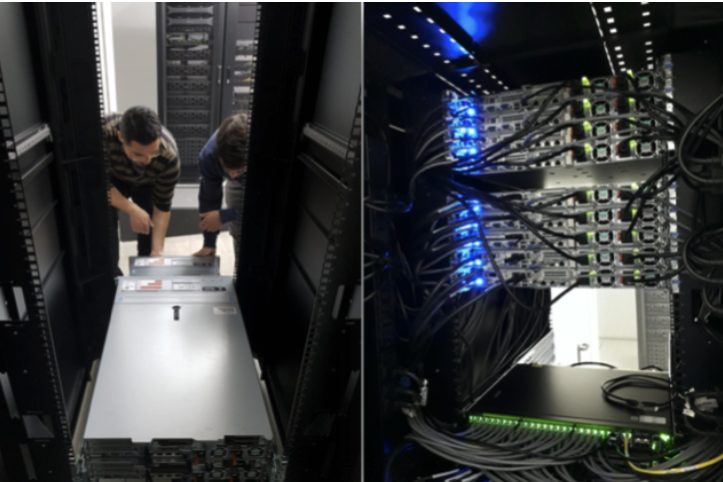
Members of the Spanish SKA team assembling the servers for the Spanish SRC Prototype (2020). Credit: IAA-CSIC
For her part, Lourdes Verdes-Montenegro, a researcher at the IAA-CSIC, coordinator of Spanish participation in SKAO, and head of the espSRC, emphasizes that “SKAO embraces sustainability and open science among its founding principles, and our prototype stands out as a benchmark for implementing both aspects within the SRCNet.” Open science is based on the principle of research reproducibility. According to UNESCO, this approach is increasingly recognized as a fundamental accelerator for achieving the Sustainable Development Goals (SDGs). To this end, it is essential that data, methods, and analytical tools be available to society. “SKAO will change the way science is done: it will no longer be possible to work locally on our computers, and the SRCs will constitute the scientific core of SKAO, providing an environment that fosters and facilitates collaboration between international teams following the principles of open science,” concludes Lourdes Verdes-Montenegro.
Jan 23, 2025 | All, Science, SKAO
23/01/2025 - A new era in astrophysics: Preparing for early science with the SKAO
Görlitz, Germany, 16-20 June, 2025
Abstract deadline: February 7, 2025
Registration is now open, early reduced-rate registration closes March 31.
More information and registration:
https://www.skao.int/en/science-users/skao-science-meeting-2025
Taking place just two years before the SKA telescopes will be tested on the first community-chosen targets, the meeting will bring together scientists from across the globe to discuss and collaborate on the cutting-edge science opportunities that the SKAO will provide in its early years of operations. Online participation will be supported for the whole week for those unable to attend in person.
Full details about the meeting are available at the #SKAOsci2025 website. #SKAOsci2025.
Jan 23, 2025 | All, Science, SKAO
Note that the SKAO White Book early draft deadline has been adjusted, and instead there is a general deadline for chapter submissions of September 2025,whereupon a peer review process will commence.
Chapters will have a maximum length of 8 pages. More info, latex templates, etc, available here: https://www.skao.int/en/science-users/557/advancing-astrophysics-ii