Jan 27, 2026 | All, Science, SKAO
27/01/2026 – The SKA Observatory’s growing telescope array in South Africa, SKA-Mid, has achieved “first fringes” using two of its dishes, a milestone that demonstrates it is operating as an interferometer for the first time.
“This is the first true test that all our systems are working together, and that the SKA-Mid telescope is alive as a scientific instrument,” said SKAO Director-General Prof. Philip Diamond.
“Having each dish observe the sky individually is an achievement, but having them operate in concert as one telescope is a much bigger technical challenge, and our teams have now achieved that milestone.”
SKA-Mid, like its counterpart SKA-Low in Australia, is an array where many individual antennas are connected by optical fibre to act like one much larger telescope, equivalent in size to the distance between its furthest antennas. "Fringes” are obtained when signals received by two or more antennas are combined successfully.
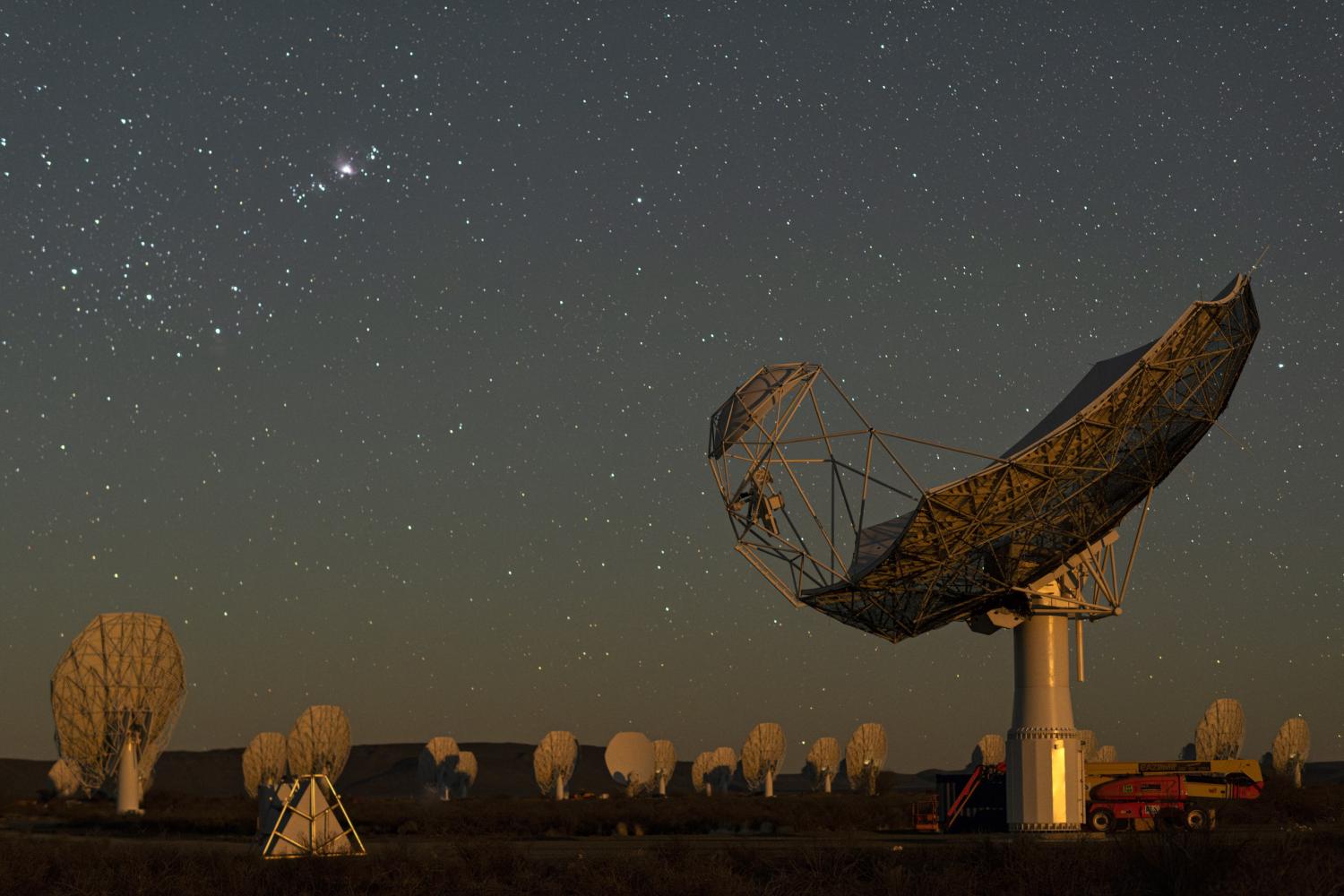
One of the seven SKA-Mid dishes now constructed on site in South Africa's Northern Cape, with SARAO's MeerKAT radio telescope in the background. Credit: SKAO/Max Alexander.
Two of SKA-Mid's 15m-diameter dishes were used together to achieve the result, observing a radio galaxy estimated to be around 2.6 billion light years away.
“This source has been well studied so we know what the signal should look like, and that’s what we observed with this first fringes result. It confirms that all our hardware and software systems are working as we designed them to do, giving us confidence as we begin to commission the telescope,” said Dr Betsey Adams, SKA-Mid Commissioning Scientist.
“That includes seeing that the dishes can track across the sky in a coordinated way under the control of the telescope manager software, the receivers are being cooled to the required temperature of minus 250°C, the synchronisation and timing system is accurately timing signals from the different dishes to a billionth of a second, and the correlator is correctly processing and aligning the data.”
SKA-Mid now has seven dish structures assembled on site in the Northern Cape, with a further 12 on their way from the manufacturers CETC54 in China. When complete the telescope will comprise 197 dishes, including the integration of the existing MeerKAT radio telescope built and operated by the South African Radio Astronomy Observatory (SARAO). The hardware and software for the SKA telescopes are being developed in the Observatory's member states, including Spain. Specifically, the time signal distribution and synchronisation system, which is key to performing interferometry. This technology has been developed by the Spanish company Safran Electronics & Defence Spain, based in Granada, which is also responsible for the same system for the SKA-Low telescope in Australia.
“Starting the year with this news is a huge boost for the teams that have worked extremely hard to see it happen, including SKAO and SARAO colleagues, and our global and local partners who are contributing to the infrastructure, hardware and software for SKA-Mid,” said Ben Lewis, SKA-Mid Senior Project Manager.
“With all we’ve learned from these months building up to first fringes, we’re in a strong position to achieve our next milestone – the first image from a four-dish array within the next few months – and then to see SKA-Mid gradually grow in size and capabilities from there.”
Across the ocean in Australia, the SKA-Low telescope continues to grow at pace. Around 70 antenna stations, each comprising 256 antennas, have now been installed at Inyarrimanha Ilgari Bundara, the CSIRO Murchison Radio-astronomy Observatory on Wajarri Yamaji Country in Western Australia. Last year its first image was released, using an early version of the telescope comprising four connected stations – 1,024 antennas – or less than 1% of the complete telescope.
As work continues to commission stations and integrate them into the array, planning is underway for the start of science verification activities with SKA-Low in 2027, when the first data will be released to the community for test observations.
Jan 16, 2026 | All, Industry, SKA-spain
16/01/2026 – El equipo de coordinación de la participación nacional en el proyecto SKA asistió el pasado mes de diciembre a la II Jornada de Grandes Infraestructuras de Investigación del CSIC y al Big Science Industry Forum Spain (BSIFS).
The coordination team for the Spanish participation in the SKA project (SKA-Spain) took part in two national forums related to large scientific infrastructures, reinforcing the key role of the scientific community and national industry in areas such as scientific data management, Open Science, digital transformation, and artificial intelligence.
Within the framework of the II Jornada de Grandes Infraestructuras de Investigación del CSIC, held on 2nd December, Julián Garrido from the Instituto de Astrofísica de Andalucía (IAA-CSIC), and co-PI of the SKA-Spain coordination, participated in the round table “EOSC en el CSIC. Gestión de datos en las Grandes Infraestructuras de Investigación: estrategia, impacto y ciencia abierta”. During his intervention, Garrido presented the SKA Observatory (SKAO) as an example of an infrastructure that will foster Open Science, highlighting the challenges associated with managing massive data volumes (on the order of hundreds of petabytes per year). He also emphasized the role of the international SKA Regional Centres (SRCNet) as a key element to guarantee access, processing and scientific reuse of these data.
The discussion underscored the need for robust institutional strategies and sustained funding for data management, as well as the importance of integrating the FAIR principles and Open Science as foundational elements of scientific infrastructures. In this context, the efforts made in Spain to incorporate scientific reproducibility as a success metric within the SKA were highlighted, along with initiatives to ensure that, after embargo periods, data are integrated into public archives accessible to the scientific community. The potential role of the European Open Science Cloud (EOSC) as a reference framework to reduce technological barriers for researchers and data managers was also discussed.
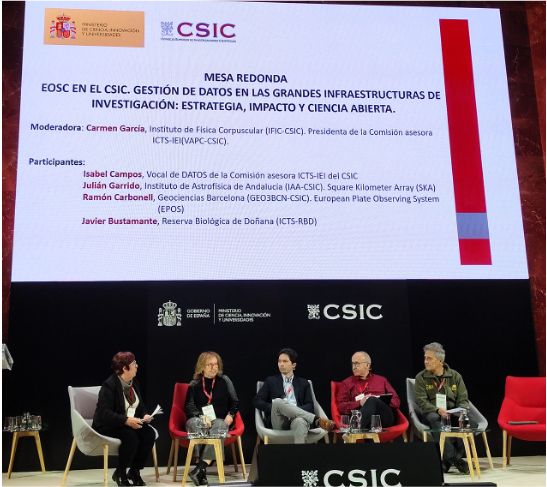
From left to right: Carmen García (IFIC-CSIC – Chair of the CSIC ICTS-IEI Advisory Committee and moderator of the session); Isabel Campos (IFCA-CSIC – Data Representative of the CSIC ICTS-IEI Advisory Committee); Julián Garrido (IAA-CSIC – co-PI of the coordination of SKA-Spain); Ramón Carbonell (GEO3BCN-CSIC – Vice-Chair of the CSIC ICTS-IEI Advisory Committee); and Javier Bustamante (EBD-CSIC – Deputy Director of the ICTS-DOÑANA).
On the other hand, the SKA project was also represented at the Big Science Industry Forum Spain (BSIFS), held on 3–4th December 2025. The participation of Spanish companies involved in the project, together with the SKA-Spain coordination team, made it possible to share experience in flagship scientific infrastructures such as the SKAO, particularly in aspects related to large-scale data management, Open Science, and sustainability. Specifically, Lourdes Verdes-Montenegro (IAA-CSIC), coordinator of SKA-Spain, took part in the round table “Transformación digital e Inteligencia Artificial”This session, focused on interaction between science and industry, addressed the impact of Artificial Intelligence as a driver of technological, productive, and social change. During her intervention, Verdes-Montenegro highlighted the role of the TED4SKA project in developing AI-based solutions to optimize energy sustainability and data management at the Spanish node of the SRCNet (espSRC), stressing the need to ensure the reproducibility and reliability of scientific results in an increasingly automated environment.
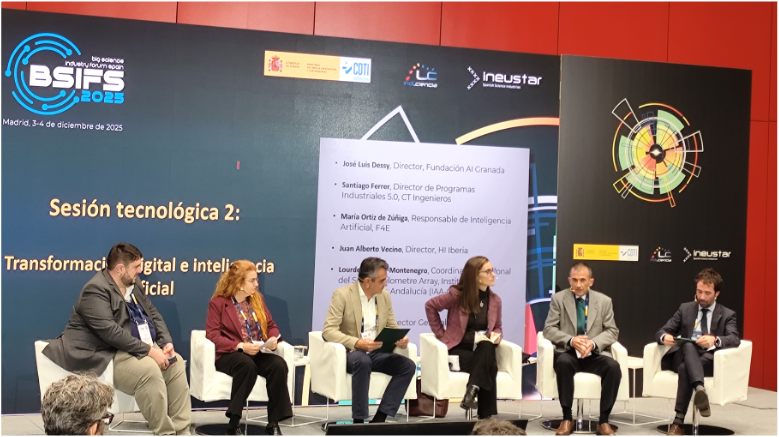
From left to right: José Luis Dessy (Director of the AI Granada Foundation); Lourdes Verdes-Montenegro (Research Professor at IAA-CSIC and Coordinator of SKA-Spain); Juan Alberto Vecino (Director of HI Iberia); María Ortiz (Head of Artificial Intelligence at F4E); Santiago Ferrer (Director of Industrial Programs 5.0 at CT Ingenieros); and Eric Fernandez (CEO of Ineustar and session moderator).
The BSIFS also highlighted the importance of strengthening connections between large scientific infrastructures and the national industrial ecosystem, identifying the need for specialized talent, public–private cooperation, and regulatory frameworks that promote the responsible adoption of Artificial Intelligence. “The organization of this type of activity helps to establish highly valuable dialogues for the scientific community, the science industry, and society,” notes Verdes-Montenegro. In this context, the event organizers facilitated meetings between participants. The coordination team held formal meetings with seven companies that expressed interest in the SKAO and the SRCNet, as well as in potential future opportunities for industrial participation.
Oct 8, 2025 | All, Industry, SKAO
08/10/25
Opportunity Description
The Square Kilometre Array Observatory (SKAO) continues to progress the construction of the SKA-Low telescope, located at Inyarrimanah Ilgari Bundara, the CSIRO’s Murchison Radio-astronomy Observatory in Western Australia.
To meet delivery milestones and optimise internal resources, the SKAO intends to award a contract for the assembly and deployment of approximately 50,000 lightweight aluminium SKA-Low antennas to a suitably qualified contractor. The estimated contract value is AUD $5 million (€2.8 million), with commencement expected in early 2026 and a duration of 12–24 months, covering full assembly and deployment within the central core area. The SKAO will retain technical oversight of specialised activities such as Power and Signal Distribution (PASD), integration, and system-level commissioning.
Scope of Work
The selected contractor will be responsible for:
- Assembling and deploying antenna stations within the designated core area.
- Coordinating with SKAO-provided antenna assembly facilities on site.
- Managing and transporting personnel, including provision of light vehicles.
- Complying with SKAO’s QA/QC and technical specifications.
- Adhering to site Health, Safety and Environmental (HSE) requirements.
The SKAO will provide:
- Assembly facilities and ergonomic tools.
- Detailed technical documentation and Standard Operating Procedures (SOPs).
- Detailed technical documentation and Standard Operating Procedures (SOPs).
- Detailed technical documentation and Standard Operating Procedures (SOPs).
Each SKA-Low antenna stands approximately 2 metres tall, weighs around 11 kg, and consists of:
- 4 aluminium antenna arms
- 3 plastic spacers
- 2 Low Noise Amplifiers (LNAs)
- 2 coaxial cables
- 1 motherboard
All fasteners, fixings, and ergonomic assembly tools will be provided by SKAO to support on-site work.
Commitment to Local and Indigenous Engagement
The SKAO is committed to supporting economic participation and development opportunities for the Wajarri Yamaji, the Traditional Owners and Native Title Holders of the lands on which the observatory is being built. Local and Indigenous businesses and consortia are especially encouraged to apply, particularly those demonstrating one or more of the following elements:
- Businesses that are at least 50% Wajarri-owned, and registered with the Wajarri Business Directory, the Aboriginal Business Directory WA, or Supply Nation.
- Proposals that include subcontracting or partnering with local and Indigenous businesses.
- Initiatives that deliver sustainable economic and social benefits to the Indigenous community, such as employment, training, or community engagement programs.
Important Dates
- Notice publication period: 8 September – 3 November 2025
- Application deadline: 3 November 2025 (23:59:59 CET)
- Expected contract start: early 2026
Call link
Official qualification notice and documentation available on the SKAO procurement portal..
Oct 8, 2025 | All, Industry, SKAO
08/10/25
Opportunity Description
The SKA Observatory (SKAO) has published a Market Survey Notice for the SKA-Low Central Power Station Phase 2 project, located at the Murchison Radio-astronomy Observatory (Inyarrimanah Ilgari Bundara) in Western Australia.
The objective of this survey is to gather input from the market on the readiness, capability, and interest of potential suppliers to design, build, and operate a remote hybrid power station that will supply electricity to the SKA-Low telescope site under a long-term Power Purchase Agreement (PPA).
Scope of Work
The selected contractor will be responsible for:
- Designing, building, and operating a hybrid power station (diesel / solar photovoltaic / battery).
- Integrating the existing Phase 1 diesel system into the new Phase 2 infrastructure.
- Integrating the existing Phase 1 diesel system into the new Phase 2 infrastructure.
- Maximising the contribution of renewable energy sources, with an estimated photovoltaic capacity between 8 and 16 MWp.
- Ensuring reliable and efficient power delivery to the SKA-Low telescope through the existing 11 kV network.
Key Requirements
- Demonstrated experience in the design, construction, and operation of hybrid energy systems.
- Technical and financial capability to undertake a long-term PPA.
- Understanding of the regulatory and operational environment in Western Australia.
- Interest and availability to participate in the forthcoming Invitation to Tender (ITT) process to be launched by SKAO.
Commitment to Local and Indigenous Engagement
The SKAO is committed to supporting economic participation and development opportunities for local and Indigenous communities, particularly the Wajarri Yamaji, the Traditional Owners and Native Title Holders of the lands where the observatory is located. Participation is especially encouraged from local and Indigenous companies and consortia that include one or more of the following elements:
- Businesses that are at least 50% Wajarri-owned, and registered with the Wajarri Business Directory, the Aboriginal Business Directory WA, or Supply Nation.
- Proposals that include subcontracting or partnering with local and Indigenous businesses.
- Initiatives that deliver sustainable economic and social benefits to the Indigenous community, such as employment, training, or community engagement programs.
Important Dates
- Preliminary publication of specifications: 8 September 2025
- Planned start of ITT process: to be announced soon
Call link
Official documentation and Market Survey Notice available on the SKAO procurement portal..
Aug 12, 2025 | All, Industry, SKAO
11/08/25
Opportunity Description
The Square Kilometre Array Observatory (SKAO) has launched a Market Survey Notice for the provision of inspection and quality control services for large precision metal structures manufactured in China. The work is linked to the production of critical components for the SKA-Mid radio telescope, located in South Africa.
Scope of Work
The contractor will be required to:
- Carry out inspections of materials and components at source.
- Verify measurements and tolerances during production.
- Oversee quality testing and dimensional control.
- Review and approve shipments, including supervision of loading.
- Prepare technical reports and follow up on any issues.
- Support visits by SKAO personnel to suppliers in China.
Key Requirements
- Specialised personnel based in China, available at short notice for on-site inspections.
- Chinese nationality for assigned personnel (security requirement).
Important Dates
- Planned procurement process start date: 18 August 2025
- Deadline to express interest: 15 September 2025
Call link
Market survey and official documentation available on the SKAO procurement portal.
Jul 17, 2025 | All, SKAO
17/07/2025 – Jessica Dempsey will be the next Director-General of the SKA Observatory from June 2026
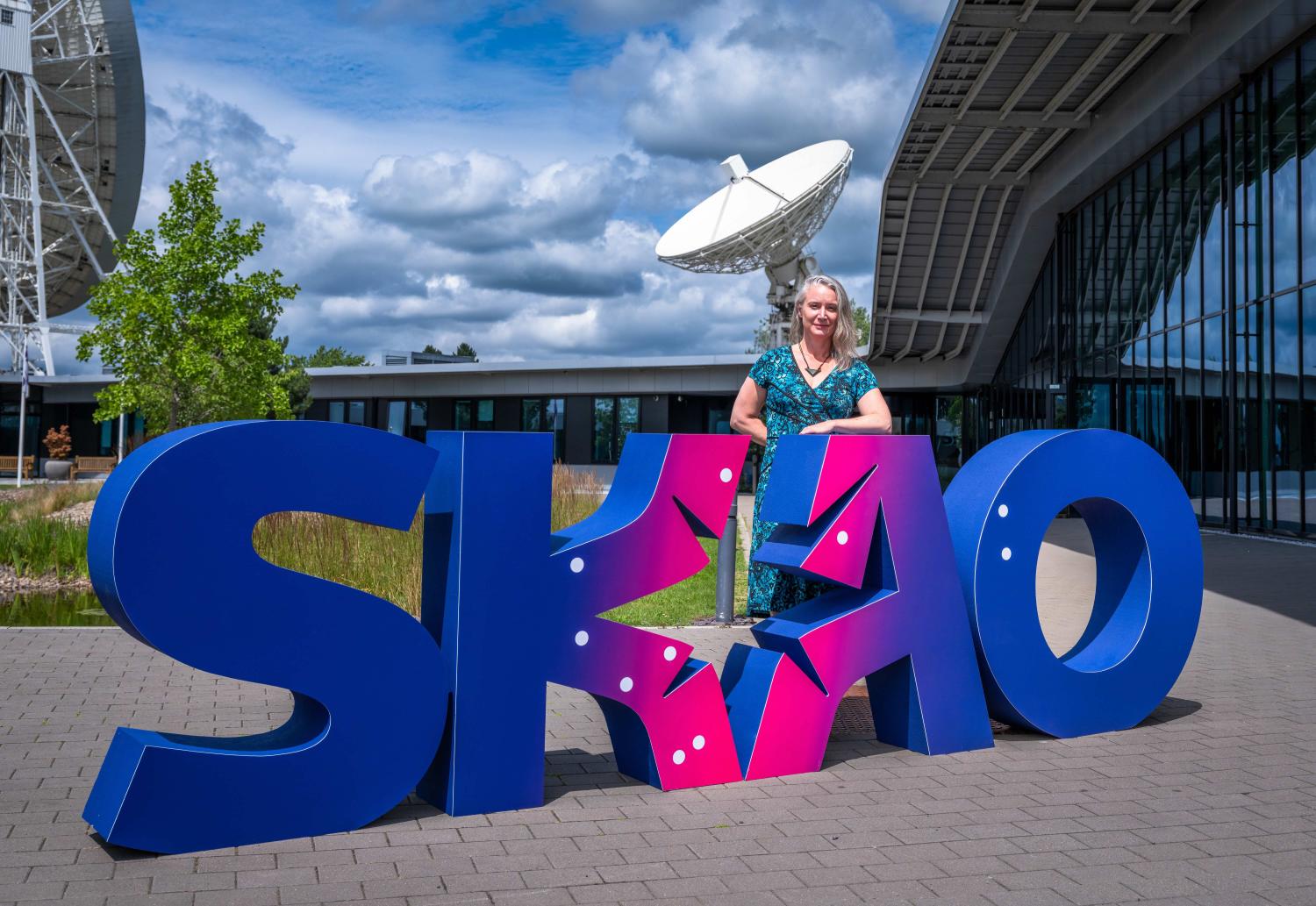
Prof. Jessica Dempsey in front of the SKAO Global Headquarters at Jodrell Bank. Credits: SKAO
The SKA Observatory (SKAO) has announced the appointment of Dr Jessica Dempsey as the next Director General. The current director of ASTRON (Netherlands) will assume the role in June 2026 for a five-year term, taking over from Philip Diamond, who has led the intergovernmental organisation since it was established in February 2021.
Dempsey will lead the SKAO during a key phase that includes the end of construction of the SKA-Low (Australia) and SKA-Mid (South Africa) telescopes, the preparation for the start of the scientific verification phase—scheduled for the first half of 2027—and the project’s transition from construction to its initial scientific operations.
The appointment was approved by the SKAO Council, composed of representatives of the twelve member countries. The decision highlights Dempsey's strong experience in managing large international scientific infrastructures and his commitment to the principles of diversity, equity and inclusion.
More information: skao.int