May 25, 2022 | All, SKA-spain, SKAO
25/05/2022 – The Square Kilometre Array (SKA) will enable progress to be made in the search for signs of life in the galaxy and in the observation of pulsars, black holes and gravitational waves. The technical coordination of the Spanish participation in the project is carried out by the Institute de Astrophysics of Andalusia (IAA-CSIC)
The Council of Ministers has approved this Tuesday the agreements by which the Ministry of Science and Innovation will allocate 2.5 million euros to the international radiotelescope Square Kilometre Array (SKA), of which 0.7 million euros will come from the European funds of the Recovery, Transformation and Resilience Plan and will be devoted to the development of its instrumentation.
The SKA radiotelescope will consist of hundreds of thousands of antennas of different types, spread over different locations, ranging from the Karoo Desert in South Africa, which will host the core of high and medium frequency dishes, to the Murchison Shire in Australia, which will host the low frequency antennas.
The SKA will be thousands of times faster at observing the sky than the best radioastronomy facilities today and will enable astronomers to make sky observations in great detail, exceeding the image resolution quality of the Hubble space telescope by several orders of magnitude.
In this way, the SKA radio telescope will make ground-breaking contributions to astrophysics, astrobiology, fundamental physics, geophysics and geodesy. Among other functionalities, it will enable progress to be made in the search for signs of life in the galaxy and the observation of pulsars, black holes and gravitational waves.
Spain's participation in SKA
Our country has been participating in SKA since 2011 and has expressed its interest in participating as a full partner in the SKA observatory which, under the legal form of an international body, will be the entity responsible for carrying out the construction of the world's largest radiotelescope.
Part of the amount approved on Tuesday will be recognised by SKA as part of the agreed contribution with which Spain will become a full member.
The technical coordination of the Spanish participation in the project is the responsibility of the Institute of Astrophysics of Andalusia (IAA-CSIC), which belongs to the Consejo Superior de Investigaciones Científicas (Spanish National Research Council), an agency of the Spanish Ministry of Science and Innovation, whose main role is to organise the national scientific community for its participation in the project.
At present, astrophysicists from Spain are involved in almost all the science working teams of the SKA, as well as in other groups, such as the energy supply options or the coordination of the regional centres. In addition, a representative of the CDTI has been appointed to encourage Spanish industrial participation in SKA developments.
Aug 27, 2021 | All, Science
27th August 2021 – The IAA-CSIC heads one of the eleven articles that make up a special issue of the journal Astronomy & Astrophysics on the results of LOFAR
After almost a decade of work, an international scientific team has published the most detailed images ever obtained of galaxies, which provide information about their internal workings in unprecedented detail. The images were created from data collected by LOFAR (Low Frequency Array), a network of more than 70,000 small antennas distributed throughout Europe. The images and the associated scientific results have been published in a special issue of the journal Astronomy & Astrophysics, one of them headed by the Institute of Astrophysics of Andalusia (IAA-CSIC).
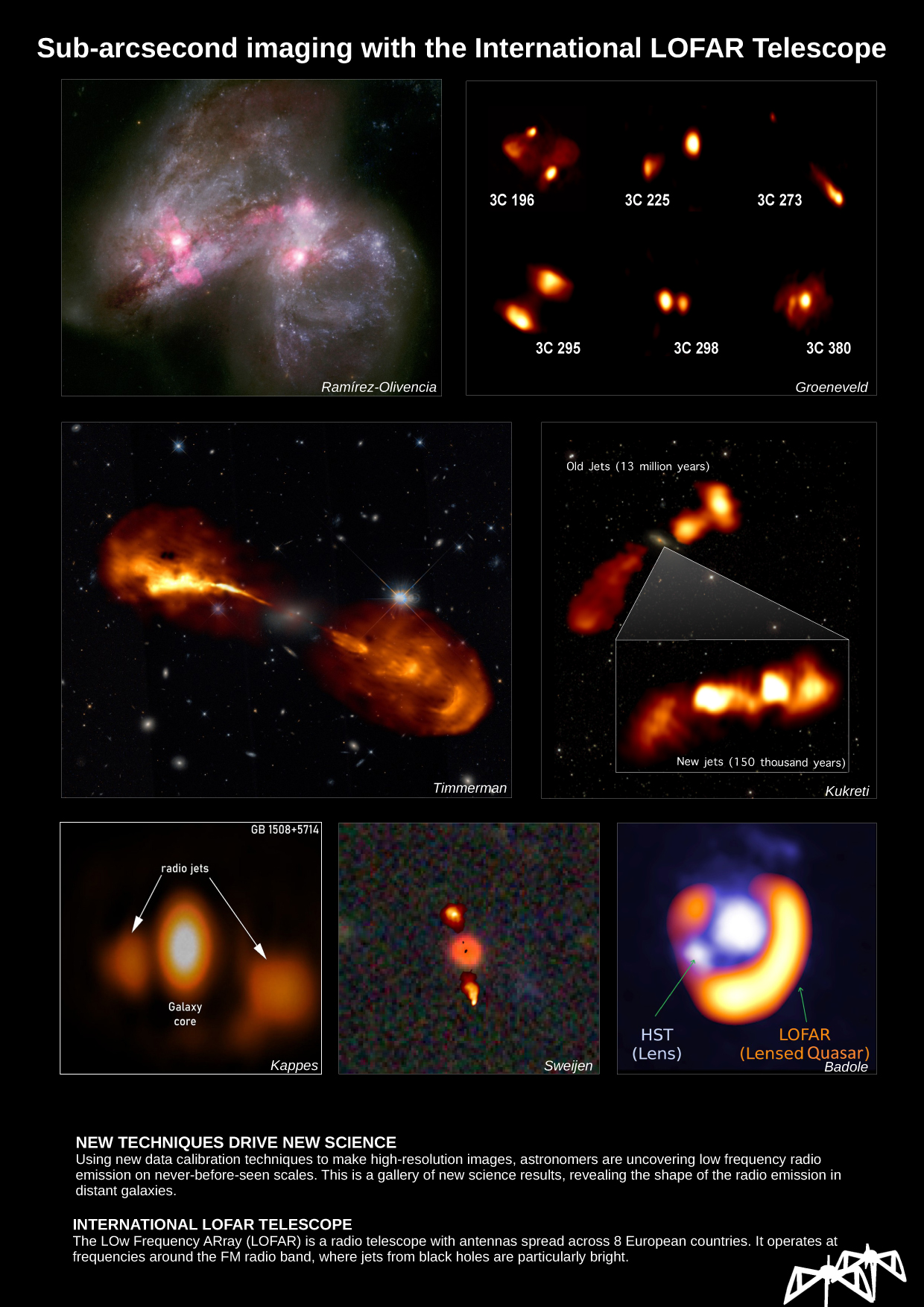
A compilation of the science results. Credit from left to right starting at the top: N. Ramírez-Olivencia et al. [radio]; NASA, ESA, the Hubble Heritage Team (STScI/AURA)-ESA/Hubble Collaboration and A. Evans (University of Virginia, Charlottesville/NRAO/Stony Brook University), edited by R. Cumming [optical], C. Groeneveld, R. Timmerman; LOFAR & Hubble Space Telescope,. Kukreti; LOFAR & Sloan Digital Sky Survey, A. Kappes, F. Sweijen; LOFAR & DESI Legacy Imaging Survey, S. Badole; NASA, ESA & L. Calcada, Graphics: W.L. Williams.
The universe is flooded with electromagnetic radiation, of which visible light, the one captured by our eyes, is only a small portion. From short wavelengths, like gamma rays and X-rays, to long wavelengths, like radio, each part of the spectrum of light reveals something unique about the universe.
The LOFAR network captures images at radio frequencies that, unlike shorter wavelength sources such as visible light, are not blocked by clouds of dust and gas that can obscure astronomical objects. Thus, regions of the sky that appear dark to our eyes glow brightly in radio waves, and radio telescopes allow us to observe areas obscured by dust, such as regions where stars form or the heart of galaxies.
The new images obtained with the LOFAR network go beyond the limits of what we know about galaxies and supermassive black holes. The images reveal the inner workings of both nearby and distant galaxies with a resolution twenty times sharper than typical LOFAR images, made possible by the unique way the team made use of the network.

This image shows real radio galaxies from Morabito et al. (2021). The gif fades from the standard resolution to the high resolution, showing the detail we can see by using the new techniques. Credit: L.K. Morabito; LOFAR Surveys KSP
The more than 70,000 LOFAR antennas are spread across Europe, with the majority in the Netherlands. In standard operation, only signals from antennas located in the Netherlands are combined and a virtual telescope is created with a collecting surface of about 120 kilometers in diameter. By using signals from all European antennas, the team has increased the diameter of the "lens" to nearly two thousand kilometers, providing a twenty-fold increase in resolution.
Furthermore, unlike conventional array antennas that combine multiple signals in real time to produce images, LOFAR uses a new concept in which the signals collected by each antenna are digitized, transported to the central processor, and then combined to create an image. Each LOFAR image is the result of combining the signals of more than 70,000 antennas, which makes its extraordinary resolution possible.
A CHALLENGE OF A DECADE
Even before LOFAR began operating in 2012, the European scientific team began to work on the colossal challenge of combining the signals of more than 70,000 antennas located at a distance of up to two thousand kilometers. "Our goal is that our work allows the international scientific community to use the entire European network of LOFAR telescopes for their own science, and to create high-resolution images with relative ease without having to spend years acquiring the knowledge," says Leah Morabito, researcher at Durham University who has coordinated the work.
The LOFAR results provide new perspectives on known galaxies, show their structure in detail and allow the detection of jets and ejections of material emerging from supermassive black holes in galactic nuclei. Specifically, the Institute of Astrophysics of Andalusia (IAA-CSIC) has contributed with a study of the galaxy Arp-299, which stands out for its high rate of supernova production, or explosions produced by the death of stars with more than eight times the mass of the Sun.
"At the IAA we have been investigating this galaxy for years, which due to the interaction with the companion galaxy is generating outbreaks of star formation -says Naím Ramírez-Olivencia, IAA researcher who heads the study-. It is, therefore, a very interesting object because it allows us to study in almost real time how stars are born, die and interact with the surrounding environment ".
"Our work has been chosen for this compendium of articles related to LOFAR because it is one of the first to show the capabilities of this wonderful instrument for low radio frequencies. Thanks to LOFAR we have managed to detect, for example, a gas outflow emanating from one of the nuclei of the Arp299 galaxy system, and with a scale comparable to the galaxy from which it emanates. Such a result has only been possible thanks to the great sensitivity and resolution of LOFAR, which in its current configuration constitutes a milestone in the astronomy and opens up a world of new discoveries", concludes the researcher.
Reference:
Jul 15, 2021 | All, Science
15th July 2021 – Its abundance in neutral hydrogen suggests that it is a group of galaxies in the process of formation
Most galaxies with intense star formation are contained within a cloud of cold neutral hydrogen, which acts as the fuel from which new stars will form. It is a diffuse, extremely faint gas that can only be detected at radio wavelengths and extends beyond the visible region of the galaxy. The observation of this gas allows us to understand the evolutionary processes that take place in galaxies, and a scientific team with the participation of the Institute of Astrophysics of Andalusia (IAA-CSIC) has found, with the MeerKAT radiotelescope, an ideal object of study: the group of galaxies richest in neutral hydrogen known.
"The distribution of neutral hydrogen in these galaxies has revealed interesting perturbed morphologies that suggest that the galaxies in the group influence each other. For example, we found a pair of interacting galaxies that will potentially merge to form a new galaxy with a completely transformed appearance", says Shilpa Ranchod, a researcher at the University of Pretoria who leads the study.
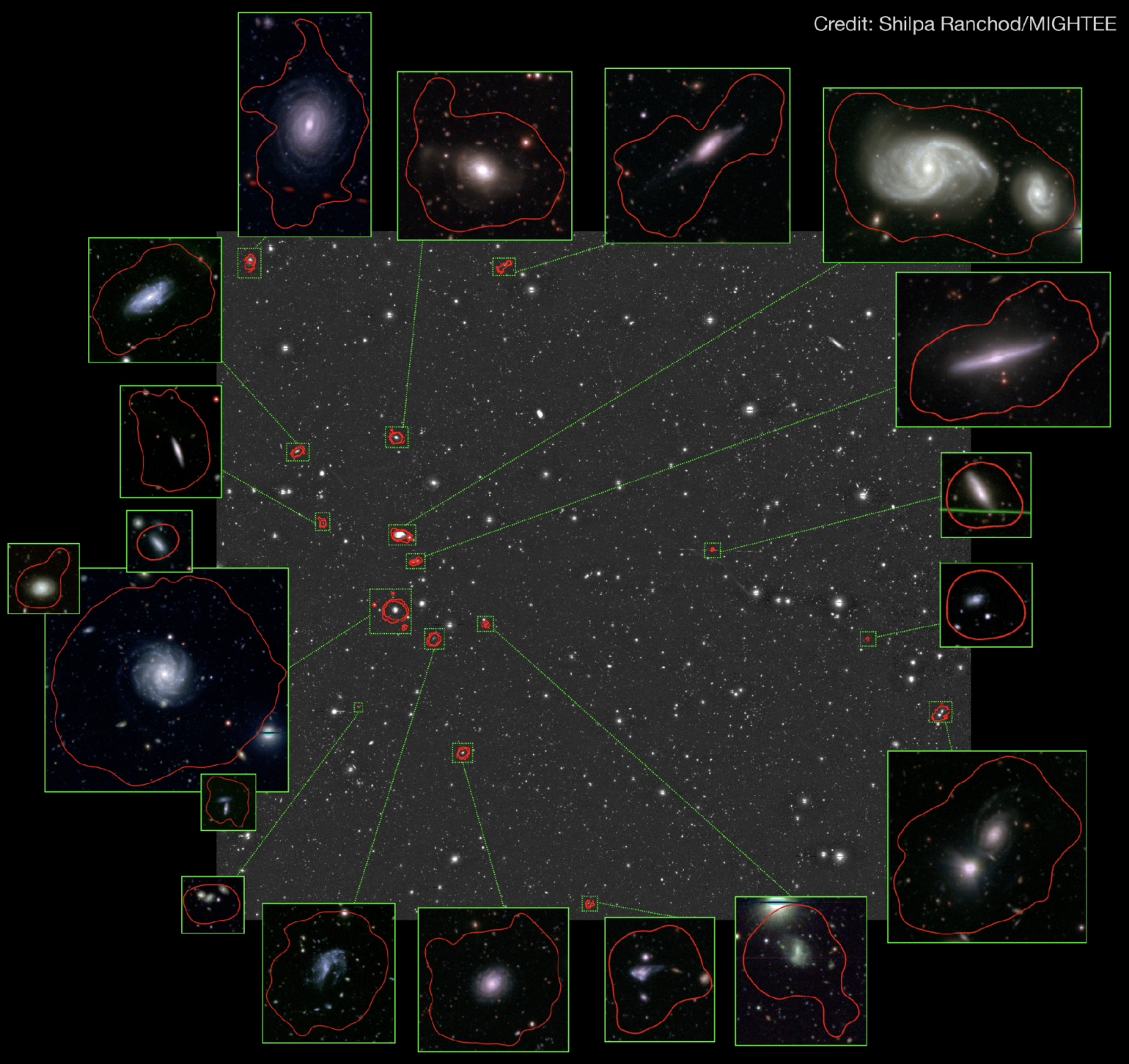
Image of the galaxy cluster with three-color optical images of each member galaxy using data from the Hyper-Suprime camera on the Subaru telescope. The red outline indicates the extent of neutral hydrogen around each galaxy. Credit: Shilpa Ranchod / Project MIGHTEE / HSC.
The discovery is part of the MIGHTEE (MeerKAT International Gigahertz Tiered Extragalactic Exploration) legacy project, one of the major surveys being developed with the MeerKAT telescope (South Africa) and involving an international science team. MeerKAT is the South African precursor to the Square Kilometre Array (SKA), which will be the largest scientific infrastructure on the planet, and aims to answer fundamental questions about the formation and evolution of galaxies. Its exceptional sensitivity provides a better understanding of the drivers of galaxy evolution.
This new group of galaxies lies in an area of the sky that has been studied in depth with other radiotelescopes, but only with MeerKAT has it been possible to observe the structure of the group so clearly. The environment of galaxies greatly affects how galaxies grow and evolve, and observations of neutral hydrogen with MeerKAT offer a new window into these structures.
"This is just a preview of what the MeeeKAT legacy project MIGHTEE will show us, and of the discoveries we will make with the SKA. This is a case of special interest for the line of research I coordinate at the IAA: unlike the dense groups of galaxies with a high deficiency in atomic gas with which we usually work and which, as we proposed, would be more evolved, in this case, a lot of gas has been detected, which suggests that we are dealing with a group in an early evolutionary phase, that is, a group in formation", says Lourdes Verdes-Montenegro, a researcher at the IAA who is participating in the study and coordinating the Spanish participation in the SKA.
This discovery will help to lay new foundations for understanding how galaxies assemble into groups and transform themselves through interaction with their environment. MeerKAT is an important step in the direction of the SKA, providing insight into future scientific projects and examples of how to overcome the many technical challenges involved in its full scientific potential.
Reference:
Reference:
S. Ranchod et al. "MIGHTEE-HI: Discovery of an HI-rich galaxy group at z = 0.044 with MeerKAT". Monthly Notices of the Royal Astronomical Society, July 2021. https://arxiv.org/abs/2107.01237
Feb 4, 2021 | All, SKAO
4th February 2021 –Spain is among the participating countries in the SKA Observatory (SKAO), an intergovernmental organization that will open a new era in radioastronomy. The Minister of Science, Pedro Duque, has highlighted that it is a milestone that will revolutionize astronomy and other scientific and technological fields. Spanish participation in SKA is led by the Institute of Astrophysics of Andalusia (IAA-CSIC)
Spain has participated this Thursday in the Council for the constitution of a new International Organization, which is the second dedicated to astronomy after the European Southern Observatory (ESO). The international radioastronomy observatory SKAO, which stands for Square Kilometer Array Observatory, is a new intergovernmental body that will be dedicated to the construction and operation, in South Africa and Australia, of the two largest and most complex radio telescopes conceived to date to study key questions about the universe.
During the last two decades, Spain has played an active role in the design phase of the Observatory with an important participation of the national scientific community in defining SKA science, an effort that has been included in a white paper on related scientific aspects with the new infrastructure published in 2015, and in which 120 scientists from more than 40 national institutions participated. In addition, our industry has played an important role, contributing to most of the infrastructure design consortia. All this estimated at approximately four million euros.
Spain's commitment for the construction of the Observatory is 41.4 million euros over the next ten years. Construction of the telescopes is expected to take eight years, with the first scientific results available in the middle of this decade. In addition to the advances that SKAO will bring to astronomy, its creation will be an important boost in many other areas, such as digital and communication technologies, supercomputing or big data, and will become a motor for the ecological transition and open science.
The Minister of Science and Innovation, Pedro Duque, has celebrated the constitution of the new observatory, underlining the involvement of Spain in the exhaustive study and design process. Likewise, he has highlighted that this is the beginning of a new stage for radioastronomy thanks to the construction of one of the most ambitious telescopes in the history of astronomy.
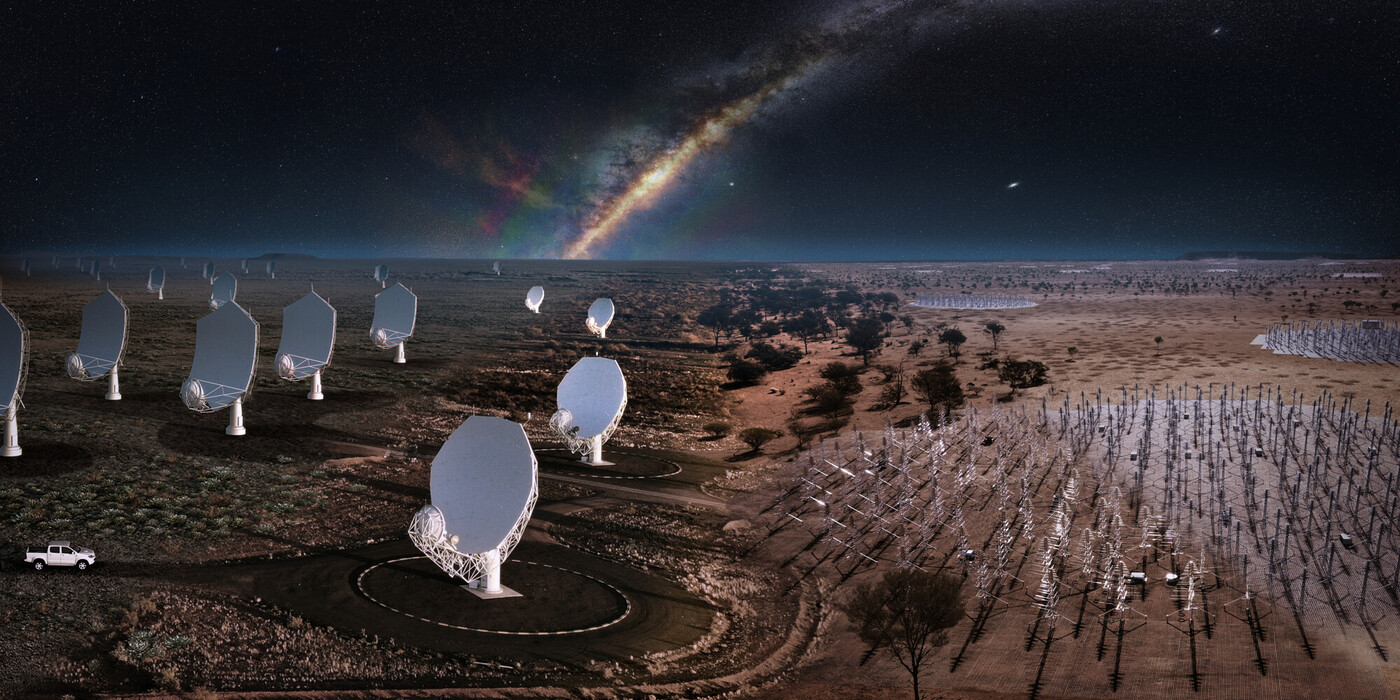
Artistic representation of SKA-Mid and SKA-Low. Credits: SKA Observatory
In addition, the minister stressed that Spain will actively participate in the new observatory, counting on a strategically positioned scientific community and a well-prepared industry.
Spanish participation in SKA is led by the Institute of Astrophysics of Andalusia (IAA-CSIC). Lourdes Verdes-Montenegro, IAA researcher and coordinator of Spanish participation in the SKA, celebrates this milestone: "Today is an exciting day, since for years the Spanish scientific and engineering community has been contributing to our participation in its first Council, which makes us witnesses of a milestone for the recent history of astronomy and positions us in the face of the key scientific projects of the SKA. SKAO shows a strong commitment to the Green Deal and Open Science, as well as to the promoting equality and inclusiveness, and brings us one step closer, through international cooperation, to the achievement of the United Nations Sustainable Development Goals". The SKA project and the development of the prototype of the "SKA Regional Center (SRC)" have the support of the management and the Severo Ochoa program of the IAA, of whose strategic plan they form a fundamental part.
Nov 30, 2020 | All, Science
30th November 2020 – MHONGOOSE, a legacy project of the MeerKAT radiointerferometer, South African precursor to the Square Kilometer Array, produces its first results. They have been obtained in its preparatory phase, thus anticipating the window that will open to the understanding of the formation and evolution of galaxies.
MHONGOOSE (MeerKAT Observations of Nearby Galactic Objects - Observing Southern Emitters) is a legacy project to study the distribution of atomic hydrogen (HI) in a selection of nearby galaxies using the MeerKAT radiotelescope (South Africa). As part of its testing phase, it has already provided its first scientific results. This first work, published in the journal Astronomy and Astrophysics, provides new findings on the distribution of gas around the galaxy ESO 302-G014 and shows the potential of the project.
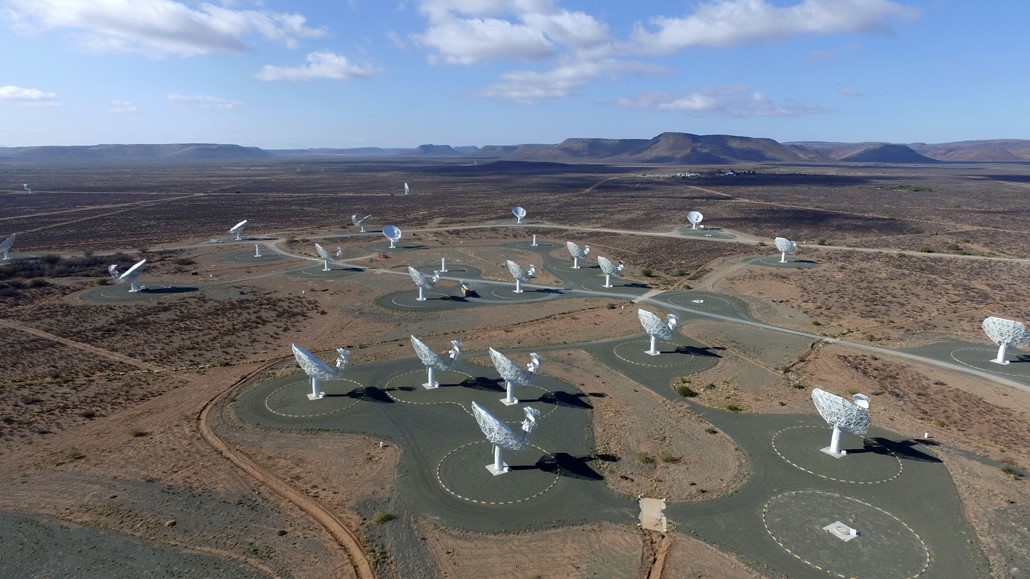
Aerial view of the MeerKAT interferometer under construction. Credit: SARAO.
MHONGOOSE will study how galaxies capture gas from their surroundings and the relationship between gas and star formation. To do so, the distribution of atomic hydrogen (HI) will be studied in a sample of 30 nearby galaxies, located less than 65 million light years from our Milky Way. The galaxies have been selected to cover all inclinations, from edge-on galaxies to front-on galaxies, and cover a very wide range in mass and luminosity.
This variety in the sample allows addressing various questions about the transformation and evolution processes of galaxies in the nearby universe. The project has obtained 1650 hours of observation in the MeerKAT radiointerferometer, a precursor of SKA (Square Kilometer Array) consisting of 64 antennas located in the Karoo desert, in South Africa. MeerKAT is, until SKA is built, the most efficient telescope to obtain the type of data that is needed in MHONGOOSE.
Gas Clouds Surrounding a Dwarf Galaxy in the Southern Hemisphere
The first results that MHONGOOSE provides correspond to the galaxy called ESO 302-G014, a nearby gas-rich dwarf galaxy. The international scientific team responsible for the work, which has the participation of the IAA-CSIC, has used observations made with MeerKAT, together with complementary data in other wavelengths, to study its evolutionary history. They have found that the galaxy has a thin, asymmetrical outer disk, as well as a tidal tail of atomic hydrogen and an isolated cloud about 6,500 light-years from this galaxy.
These structures, which had not been previously detected, seem to indicate that the galaxy underwent an interaction with another low mass galaxy. Lourdes Verdes-Montenegro, IAA-CSIC scientific researcher and the only Spanish member of the MHONGOOSE team, highlights that “the detected signs of a possible interaction with some low-mass galaxy companion are also supported by the presence of significant amounts of molecular gas detected by the ALMA interferometer and the existence of prominent star clusters, suggesting a recently induced star formation”.
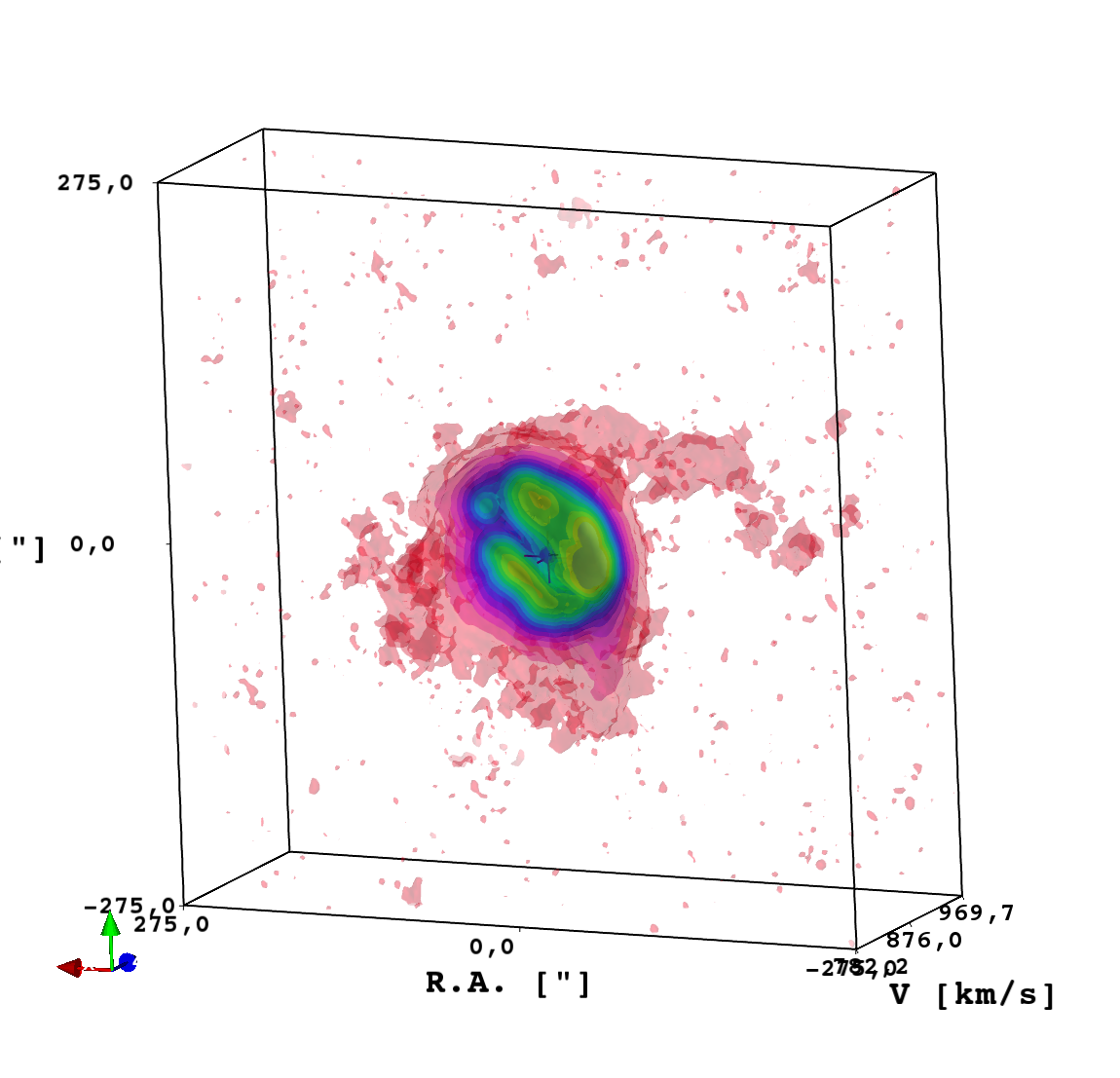
Emission of atomic hydrogen associated with the galaxy ESO 302-G014, represented in three dimensions, where the structure that could correspond to a possible interaction with a low-mass companion is shown. Credit: Lourdes Verdes-Montenegro (IAA-CSIC).
"The deep images from the Dark Energy Camera Legacy Survey show a faint and diffuse object near the end of the filament, whose radius, brightness and color are compatible with that of a dwarf galaxy at a distance similar to that of ESO 302-G014", points out Javier Román, a researcher at the IAA-CSIC expert in deep optical images who participates in the work.
These results are, according to Lourdes Verdes-Montenegro, “just a small preview of things to come”, as they have been obtained with preliminary observations, and she is confident that “in-depth observations of the objects in the MHONGOOSE sample will offer a glimpse of the fate of atomic gas when transferring from the intergalactic medium to galaxies”. In the medium-term future, these types of observations will be able to be extended to more distant galaxies thanks to SKA, which will be the largest radiotelescope in the world, and in which MeerKAT will be integrated to form a single interferometer.
Reference: